

Question
Gramps,
One of our hymns mentions Christ paid the price for sin. What price did he actually pay?
Cheryl
Answer
Cheryl,
The earliest Christians and modern believers alike have seen in the Atonement a wellspring of hope that sin and death can be overcome. The Church of Jesus Christ of Latter-day Saints teaches that this is not merely a symbolic gesture, but a real and infinite sacrifice in God’s eternal plan for His children. And yet, sincere seekers still wrestle with critical questions. Couldn’t an omnipotent and loving God have found an easier, less gruesome way? Why was the Atonement necessary at all?
To understand why Christ’s suffering mattered, we must first grasp the interplay between justice and mercy in God’s plan. From the earliest scriptural accounts, it is clear that God is both just and merciful. These are not just arbitrary traits—they are at the very core of what makes Him God. Were He to forsake justice, He would not be God; to abandon mercy, He would cease to be loving. The challenge is, therefore, how both justice and mercy can be satisfied in redeeming fallen, sinful humanity.
Imagine the often-used analogy of a debtor who cannot pay, no matter how hard he tries; the currency he has is insufficient to cover the debt. This is analogous to our predicament: We have no currency that is valid in heaven. We could give everything we have and it is not sufficient to pay the debt we owe for our sins.” The law of justice demands full payment for every transgression. Mercy, on the other hand, seeks to forgive and renew. But, as ancient and modern prophets have taught, “mercy cannot rob justice” (see Alma 42:25). The two seem in tension until one understands the unique role of a Redeemer.
It is not that God delights in suffering; rather, the less intuitive part is how the scales of justice require payment for transgressing divine law. We don’t understand how that works, but that is somehow a factor. God is just. If he were not, he would cease to be God. To be totally just, a punishment must always be affixed to sin. The atonement balances the books.
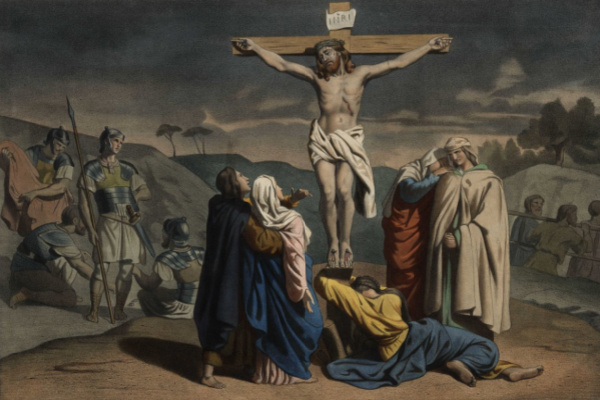
The suffering of Jesus Christ, both in the Garden of Gethsemane and on the cross, was real, personal, and infinite in scope. Latter-day Saint doctrine is clear:
“For behold, I, God, have suffered these things for all, that they might not suffer if they would repent;
But if they would not repent they must suffer even as I;
Which suffering caused myself, even God, the greatest of all, to tremble because of pain, and to bleed at every pore, and to suffer both body and spirit—and would that I might not drink the bitter cup, and shrink—” (Doctrine & Covenants 19:16-18).
From the perspective of scriptural history and divine symbolism, the shedding of blood is a motif stretching back to ancient sacrifice. The blood motif is nothing new. It is common throughout the Mosaic code, intending to conjure up just how valuable life is…All this was done in order, but that doesn’t change the bloody nature of it. Old Testament law required a blood offering for sin, a life for a life; Christ’s sacrifice thus fulfilled and transcended the symbolism, offering a real atoning power.
The intensity of Jesus’ suffering cannot be overstated. Not only did He endure physical agony, but the unique and crushing weight of every sin and sorrow mankind would ever experience. All the weight of all human suffering, pain, hardship, disease, and even death fell upon Jesus, not only in Gethsemane, but upon the cross as well. He suffered spiritual agony—the withdrawal of His Father’s presence, and the overwhelming burden of all that is dark, broken, and lost in the human experience.
But why did it have to be so “gruesome”? We must understand the symbolism: Of all the ways to die, why the cross?… On the cross, Christ served as a proxy showing us the price of discipleship…Jesus lived a sinless life. He could not show us how to repent except through allegory. And what a powerful image it is!
A heartfelt question plagues many: why can’t God forgive us, as a loving parent forgives their child? Why is suffering—even Christ’s—required at all?
The answer lies not in God’s lack of power, but in the requirements of justice and the realities of agency. If [God] had done that, He would have ceased to be God. That was exactly what Satan proposed to do! In the great council before the world began, Satan offered that all would be saved—at the price of compulsion and the loss of agency. But God’s plan is based on real choice, real consequence, and real redemption.
A loving parent might give their child a bath and a bandage, but in the realm of eternal law, we have no currency that is valid in heaven.” We cannot, by our own efforts, undo the eternal results of our own choices, any more than a debtor can pay what they do not possess. Only a perfect, sinless, and voluntary sacrifice could meet the demands of justice.
If Christ had not come, “there could have been no redemption” (Alma 12:32). Only Jesus—free from personal debt to sin and death—could offer His own life as payment for each of us. Only his life–the life of a perfect, sinless soul–was acceptable currency. Only Jesus could pay the debt. Only he could resurrect his own body and break the bands of physical death. This is why only He, and no one else, could accomplish the Atonement.
One might still ask: If the Atonement was infinite, why do people still suffer for their own sins? Why must we repent if Christ already paid the price?
The gift of the Atonement is not forced upon anyone. For that great expiation to be effective, it must be accepted by the sinning individual. To accept that Savior’s atonement on one’s behalf…requires full repentance from sin; and repentance is not an easy process. It is a life-changing process.
Repentance is the means by which we access mercy through Christ’s suffering. Without it, we are left to pay the penalty ourselves: If we do not repent, we will suffer even as Jesus did. His suffering rightly belongs to us. If His kindness and mercy are not inspiration enough to repent, certainly the ferocity of His suffering should be a prime reason.”
Yet, when repentance is sincere, the fullness and completeness of the Atonement’s effect transcends all.
The great atoning sacrifice of the Lord is so complete in its application that when a person fully and completely repents of his sins, it is as if he had never committed them at all. There is no remaining mark or stain; there is no way to differentiate that person from another who had been purified from committing other sins.
This is not mere pardon; it is transformation. The power of Christ’s suffering can make scarlet sins “as white as snow” (Isaiah 1:18), and remembers them no more (Doctrine & Covenants 58:42).
Some have wondered why a “human sacrifice” was necessary. But as the doctrine makes clear, the sacrifice of Jesus was not merely human; it was the willing sacrifice of the Son of God, who had power over death and over Himself (John 10:17-18). He did not die until he knew his work had been completed. Because of this, the atonement was not a human sacrifice but, rather, the sacrifice of the God of Israel, as prophesied in the Old Testament.
The fullness of what Christ accomplished can never be fully understood with mortal minds. Still, the result is sure: The atonement of Jesus Christ, His agony in Gethsemane, and His death on the cross are the only actions by which the wounds of sin and hurt that rend the world can be repaired. Through His suffering, Christ draws all people unto Himself and offers not mere existence, but endless and abundant life.
So what price did Christ pay? Giving of His own life seems like a pretty high price to me.
Gramps
Related Posts
 Did Jesus possess human desires and earthly pleasures just like any other mortal man?
 What did Jesus do from the time He was 12 until He began His ministry at 30?
 Why is speaking against the Holy Ghost worse than speaking against Jesus Christ?
 Why do Mormons believe that Jesus is a brother to Satan?