
Question
Gramps,
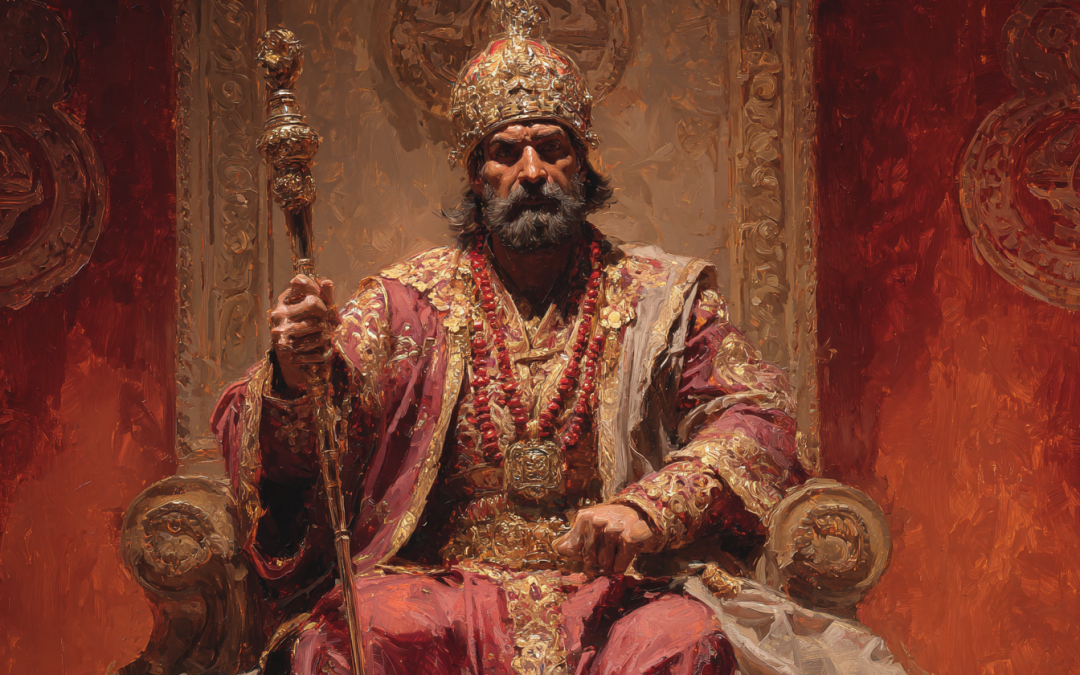
What is the thing that kings both past and present hold? What does it mean, and what does it do? There are scriptures that describe God as holding it. What purpose do you think it has?
Julius
Answer
Julius,
Let’s first take a look at some scriptures that talk about God holding a scepter.
Thy throne, O God, is for ever and ever: the sceptre of thy kingdom is a right sceptre. (Psalms 45:6)
But unto the Son he saith, Thy throne, O God, is for ever and ever: a sceptre of righteousness is the sceptre of thy kingdom. (Hebrews 1:8)
And out of his mouth goeth a sharp sword, that with it he should smite the nations: and he shall rule them with a rod of iron: and he treadeth the winepress of the fierceness and wrath of Almighty God. (Revelation 19:15)
A scepter is an ornate rod of authority that kings have held as a symbol of their rule. It has been found in ancient Egypt. It continues today in royalty. Popes are given a similar symbol of rulership upon papal ascendency. British monarchs are given dual scepters (the dove and the cross), indicating their dual role as the secular Monarch of England and the Supreme Governor of the Church of England.
SYMBOLISM:
Since ancient times, it has been understood that a scepter is a symbol of power as much as a crown is a symbol of authority. One of the deepest symbolic meanings that I’ve found is the dual symbolism behind the double scepters of Egyptian Pharaohs.
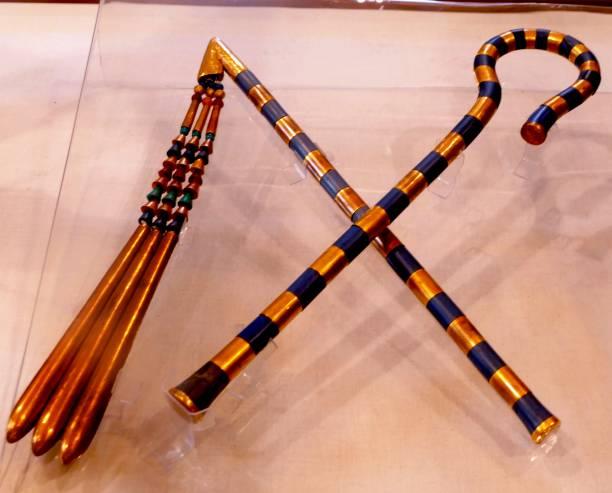
Both of these scepters have a double meaning.
- The flail can be used to punish a subject, and it can be used to thresh wheat and thus provide food for his people.
- The shepherd’s crook can be used as a weapon to strike an enemy, and it can be used to invite a subject to come closer to the presence of the monarch (bringing him into the fold).
This is the meaning of “fear” of God as well as “fear” of the King. It was a level of reverence, respect, and fear. As long as one was a faithful subject, he could approach without fear (as we think of it today), but it was with great reverence and respect — even gratitude and love.
This dual meaning of fear and love is also reflected in the phrase “His hand is stretched out still.” (Isaiah and 2 Nephi). People often wonder if His hand is stretched out in anger or in love. The answer is: Both.
We have an option to continue in sin or to repent. The same scepter is held out to all. But what will He offer us? If sin, anger; if repentance, mercy.
I included the verse from Revelation to point to something that many people miss in The Book of Mormon: The Iron Rod.
Most people tend to think that the Iron Rod is basically a stationary handrail/guardrail we walk along. I have a different interpretation.
…and they came forth and caught hold of the end of the rod of iron; and they did press forward through the mist of darkness, clinging to the rod of iron, even until they did come forth and partake of the fruit of the tree. (1 Nephi 8:24)
…and they came and caught hold of the end of the rod of iron; and they did press their way forward, continually holding fast to the rod of iron, until they came forth and fell down and partook of the fruit of the tree. (1 Nephi 8:30)
Notice that in both verses, the wording is “caught hold of the end of the rod of iron.” There was no mention of going hand over hand as they walked the path. They only grasped the END of the rod/scepter. Iron was a symbol of strength because it was the strongest metal available at the time. It was quick and powerful if used as a weapon. It was a sure anchor if used for security.
When in the presence of the King, people approached near to the throne until the King extended his scepter, inviting them to take hold of the rod/scepter. He would then draw them closer as they held onto the end of the rod/scepter. As they came near the monarch, they fell down and worshiped him. (Anciently, the word “worship” simply meant “to bow down to,” and “Fell down” simply meant “to get closer to the ground.)
Notice that we are not talking about a handrail. It is the rod extended by the monarch. We grasp it. He pulls us along the path. We walk through the mists of darkness while we are brought through it by the knowledge/power/wisdom of the King. His grace consists of
- Providing a path
- Extending the scepter
- Pulling us in (guiding us through the mists of darkness).
His grace pulls us along the path, not our walking. We cannot walk the path without grasping His scepter. This grace is an enabling power.
19 And now, my beloved brethren, after ye have gotten into this strait and narrow path, I would ask if all is done? Behold, I say unto you, Nay; for ye have not come thus far save it were by the word of Christ with unshaken faith in him, relying wholly upon the merits of him who is mighty to save.
20 Wherefore, ye must press forward with a steadfastness in Christ, having a perfect brightness of hope, and a love of God and of all men. Wherefore, if ye shall press forward, feasting upon the word of Christ, and endure to the end, behold, thus saith the Father: Ye shall have eternal life. (2 Nephi 31:19-20)
Gramps