
Question
Gramps,
When did baptism among the Nephites begin? They were living by the law of Moses, but Alma baptized others before the death and resurrection of Christ.
Karie
Answer
Karie,
Imagine yourself in ancient Bountiful: Jesus Christ, now resurrected, stands before a multitude, His wounds visible, His voice full of power. He beckons Nephi, the prophet and spiritual leader, and gives him the authority to baptize under divine commission. But why Nephi? Why here, and why now? Had there not already been baptisms among the Nephites?
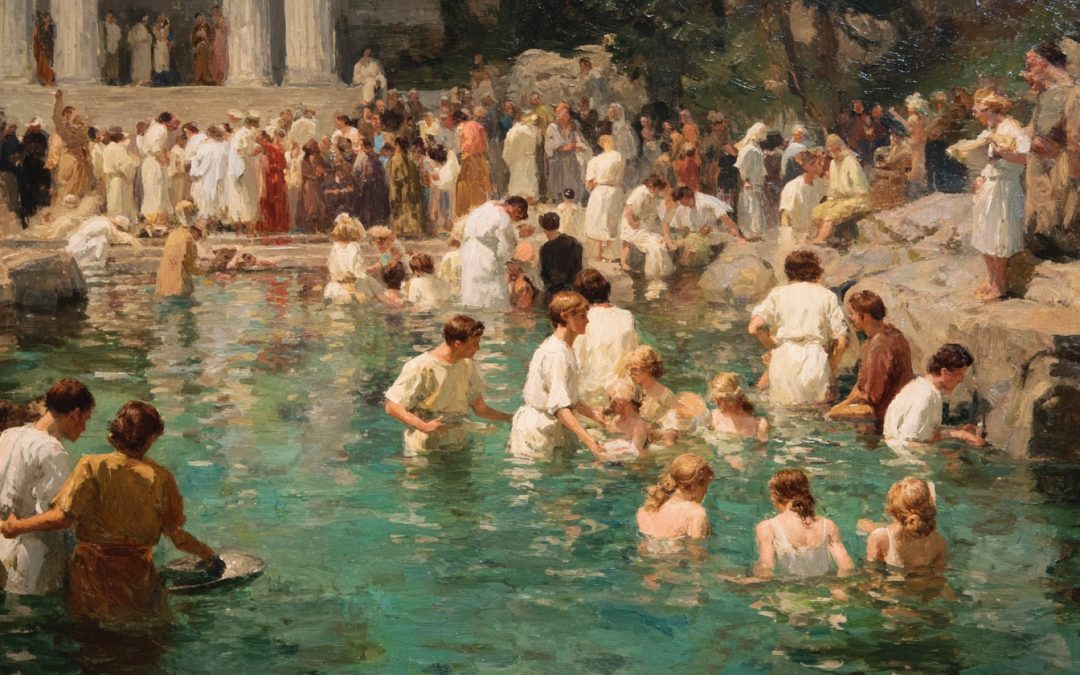
Before the arrival of Jesus Christ, the Nephite record documents that Nephi and his people practiced baptism, not merely as a cleansing ritual but as an essential commandment for salvation. This was in harmony with earlier Hebrew traditions—contrary to some assumptions, ritual immersion and baptism have ancient Jewish roots. Full immersion in natural “living” water was customary for ritual purity, conversion, and spiritual renewal; even the temple of Solomon featured a great “molten sea”, likely used for purification rites resembling baptism.
In addition, the Book of Mormon explains that this practice of baptism even predated the Law of Moses, going all the way back to Adam’s time: “the first person to be baptized was the first person, Adam” (Moses 6:52), taught as essential for the remission of sins and the receiving of the Holy Ghost.
Nephite prophets—such as Alma—taught, “what have you against being baptized in the name of the Lord, as a witness before him that ye have entered into a covenant with him, that ye will serve him and keep his commandments” (Mosiah 18:10). This indicates that baptism served not only as a ritual washing, but also as a sign of entering into a covenant with God.
But the Nephite system of priesthood and ordinances operated under the Mosaic Law, albeit with some differences—their priesthood did not follow the strict Levite lineage, but the Melchizedek order by divine appointment. Nevertheless, they awaited the day when the Law of Moses would be fulfilled in Christ.
When Jesus appears in 3 Nephi 11, the new era has arrived. He calls Nephi forth and “gave him power that he should baptize.” Why would this be necessary? As Elder Jeffrey R. Holland explained, Nephi and the others did have authority “before the Visitation of Christ… under the Mosaic Covenant.” But now, “Christ, having fulfilled the Law, established a new order with a NEW Covenant.” The Savior publicly reaffirms or re-bestows this authority “to baptize in the new gospel dispensation”—and perhaps ordains Nephi to the apostleship at the same time.
This new dispensing of authority is not redundant, but rather essential. Christ’s act does not nullify earlier baptisms or the authority the Nephites held under the prior law; instead, it marks the inauguration of His “Church of the New Covenant,” clarifies doctrine (as doubts and disputes existed among the people regarding ordinances) and establishes a new foundation for His followers, with clear and permanent priesthood authority.
One aspect that highlights the gravity of Christ’s bestowal of authority is His detailed instruction on the “how” of ordinances. In 3 Nephi 11, Jesus gives a precise formula for baptism: “Having authority given me of Jesus Christ, I baptize you in the name of the Father, and of the Son, and of the Holy Ghost. Amen.” He directs that candidates be “immersed in the water” after repentance. These instructions appear almost word-for-word in modern revelation (Doctrine and Covenants 20:72-74), with only very minor wording adjustments over time.
The wording for blessings on the sacrament—the prayers over bread and water—is similarly exact in scripture (Moroni 4-5, D&C 20:75-79). In both cases, the precise language seems designed to erase confusion and ensure unity among believers.
But while the Lord gave detailed prayers and forms, He also allowed for adaptation in how ordinances are performed according to need and revelation. For example, in 2019, the First Presidency allowed any baptized member—including children and youth—to act as witnesses to a baptism, expanding a role previously reserved for priesthood holders. Early Latter-day Saints used wine for the sacrament until a revelation permitted the use of water. And in the early twentieth century, concern for public health brought a shift from communal sacrament cups to individual ones. The core remains unchanged—authority, purpose, symbolism—but the details can adapt.
While baptism and the sacrament have their prayers recorded and rarely change, temple ordinances are not strictly set in scriptural text, and justified adaptations have been made under prophetic direction. This contrast illuminates a significant truth: divine authority and priesthood ordinances are both precise and adaptable—always under the Lord’s direction through His prophets.
Gramps