

Question
Gramps,
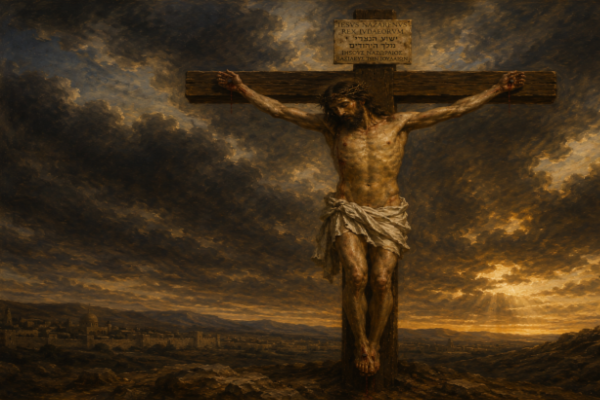
Why did God the Father formulate a plan of salvation that required the sacrifice of one of his sons in order for redemption to be made available? Why was there no other way that could not include the immense suffering of one individual? Which holy scriptural author best describes the need for the atonement of one, Jesus Christ?
David
Answer
David,
One of the deepest questions in all of religion is this: Why did Heavenly Father create a plan of salvation that required the suffering and sacrifice of Jesus Christ? If God is all-powerful, why could He not simply forgive His children without requiring the immense suffering of one of His sons?
Latter-day Saint doctrine teaches that the answer lies in the eternal nature of God, the reality of agency, and the unchanging laws of justice and mercy. The Atonement of Jesus Christ was not an arbitrary requirement. It was the only way to satisfy both justice and mercy while preserving our agency and allowing us to return to God’s presence.
To understand why, we first need to understand the problem the Atonement was meant to solve.
Before coming to earth, we lived as spirit children of Heavenly Father. His plan provided a way for us to receive physical bodies, learn through experience, and eventually become more like Him. But He also knew that every one of us would make mistakes and commit sin.
The scriptures teach that “no unclean thing can dwell with God” (1 Nephi 10:21). Because all people sin, every one of us would be separated from God forever if there were no redemption.
In addition, mortality brought physical death. Every person would eventually die and be separated from his or her body.
Humanity, therefore, faced two obstacles:
- Physical death.
- Spiritual death caused by sin.
Without divine intervention, neither obstacle could be overcome.
Some people wonder why God could not simply overlook sin. The Book of Mormon gives a profound answer. God is perfectly loving, but He is also perfectly just. If justice did not exist, there would be no meaningful consequences for good or evil.
The prophet Alma taught:
“Now, if there was no law given—if a man murdered he should die? … If there was no law given against sin men would not be afraid to sin” (Alma 42:17).
Justice requires that laws have consequences. If God simply ignored sin, He would cease to be a perfectly just God. Yet if justice alone prevailed, every person would stand condemned because all have sinned. This is where mercy enters the picture. The challenge was not merely finding a way to forgive sinners. The challenge was finding a way for mercy to operate without destroying justice.
Alma explained:
“The plan of mercy could not be brought about except an atonement should be made” (Alma 42:15).
That simple statement may be one of the clearest explanations in all scripture. Mercy could not function without an atonement. The Atonement was not merely one option among many. It was the means by which both justice and mercy could be preserved.
Among all scriptural authors, Alma likely provides the most complete explanation of why the Atonement was necessary. His teachings in Alma 34 and Alma 42 explain not only that Christ would save mankind, but why such a sacrifice was required in the first place.
In Alma 34, the prophet Amulek taught that redemption required “an infinite and eternal sacrifice” (Alma 34:10). Animal sacrifices under the law of Moses could symbolize the future Messiah, but they could not actually redeem humanity. Only a divine and infinite sacrifice could satisfy the demands of justice for all people.
Jesus Christ alone was qualified to make that sacrifice.
Because He was the Only Begotten Son of God in the flesh and lived a completely sinless life, He had no debt of His own to pay. He voluntarily offered Himself before the foundation of the world to become the Savior of mankind.
As Christ Himself declared:
“I lay down my life, that I might take it again. No man taketh it from me, but I lay it down of myself” (John 10:17-18).
The Savior was not an unwilling victim. He willingly chose to suffer for us.
Modern apostles have emphasized this truth. President Dallin H. Oaks taught that Christ’s mission was absolutely central to the Father’s plan:
“He has done everything that is essential for our journey through mortality toward the destiny outlined in the plan of our Heavenly Father.” (“What Has Our Savior Done for Us?” April 2021 General Conference)
The Atonement was not a backup plan or an emergency measure. It was the very heart of the Father’s plan from the beginning.
Still, another question often arises: Why did the suffering have to be so immense?
Doctrine and Covenants 19 teaches that Christ suffered “both body and spirit” and that His suffering caused Him to “bleed at every pore” (D&C 19:18).
The answer is that Christ did not merely pay a symbolic price. He descended below all things. He experienced the full weight of mortality so He could redeem us completely and understand us perfectly.
Alma prophesied:
“And he shall go forth, suffering pains and afflictions and temptations of every kind… that he may know according to the flesh how to succor his people according to their infirmities” (Alma 7:11-12).
President Oaks similarly taught:
“He had no debt to pay. He had committed no wrong.” (“Strengthened by the Atonement of Jesus Christ,” October 2015 General Conference)
Yet the Savior willingly bore humanity’s guilt, pain, sorrow, and suffering. Because Christ personally experienced every kind of suffering, He knows exactly how to help us in our own trials.
Elder Jeffrey R. Holland beautifully described this aspect of the Savior’s sacrifice when he testified:
“We will never be left alone nor unaided.” (“None Were with Him,” April 2009 General Conference)
That assurance comes because Jesus Christ has walked the path of suffering before us.
Through His Resurrection, Christ overcame physical death for every person who has ever lived. Through His atoning sacrifice, He made repentance and forgiveness possible for all who come unto Him.
The reach of His sacrifice is truly infinite. Elder Holland taught:
“It is not possible for you to sink lower than the infinite light of Christ’s Atonement shines.” (“The Laborers in the Vineyard,” April 2012 General Conference)
No one is beyond the Savior’s ability to redeem. No sorrow is beyond His understanding. No repentant soul is beyond His reach.
In the end, the question is not simply why suffering was required. The greater lesson is what that suffering reveals about God. It reveals that Heavenly Father loved His children enough to provide a Savior. It reveals that Jesus Christ loved us enough to willingly suffer for us. It reveals that justice would not be abandoned, but neither would mercy.
The Atonement demonstrates both God’s perfect holiness and His perfect love. Through Jesus Christ, justice is satisfied, mercy is extended, agency is preserved, and the way is opened for God’s children to return home.
That is why Latter-day Saints view the Atonement of Jesus Christ not merely as one doctrine among many, but as the very center of the Father’s plan of salvation. And among scriptural writers, perhaps no one explains that necessity more clearly than Alma, who taught that “the plan of mercy could not be brought about except an atonement should be made” (Alma 42:15). In that single verse, he summarized why the sacrifice of Jesus Christ was not merely helpful—it was absolutely essential.
Gramps