

Question
Gramps,
In the Book of Luke, it states that “And there appeared an angel unto him from heaven, strengthening him.” (Luke 22:43)
From this verse, do we have any clue who the angel is that comforted Jesus Christ in Gethsemane? Thank you for answering my question.
Regards,
Arcee
Answer
Arcee,
One of the most moving moments in the New Testament takes place in the Garden of Gethsemane. It was there that Jesus Christ began the infinite and eternal sacrifice that would make salvation possible for every one of God’s children. As He took upon Himself the sins, pains, sorrows, sicknesses, and grief of all mankind, He experienced suffering beyond anything we can truly comprehend. In the middle of Luke’s account, we find a brief statement that has caused many readers to wonder about an intriguing question:
“And there appeared an angel unto him from heaven, strengthening him.” (Luke 22:43)
The verse is only a single sentence, yet it naturally leads us to ask: Who was this angel?
The honest answer is that we simply don’t know. Neither the Bible nor modern revelation identifies the angel by name, and The Church of Jesus Christ of Latter-day Saints has never officially taught who this heavenly messenger was. While there have been various ideas over the years, they remain nothing more than personal opinions because the Lord has not revealed the answer.
Although that may seem a little disappointing, it also teaches us an important principle. Sometimes the scriptures leave out details because they are not the main point of the story. Rather than focusing on the angel’s identity, Luke seems more interested in helping us understand that Heavenly Father did not leave His Beloved Son completely alone during the greatest suffering ever experienced.
The angel’s appearance also reminds us that although Jesus was the Son of God, He was living a fully mortal life. He willingly accepted all the limitations and pains that come with mortality. Luke goes on to describe the intensity of that suffering:
“And being in an agony he prayed more earnestly: and his sweat was as it were great drops of blood falling down to the ground.” (Luke 22:44)
Latter-day Saints understand that Gethsemane was a vital part of the Savior’s Atonement. It was there that He began taking upon Himself everything that would ever afflict the human family. The prophet Alma explained why this was necessary:
“And he shall go forth, suffering pains and afflictions and temptations of every kind…that he may know according to the flesh how to succor his people according to their infirmities.” (Alma 7:11-12)
Knowing this makes Luke’s brief comment about the angel even more meaningful. The Father did not remove the suffering or lessen the demands of the Atonement. Jesus still had to drink the bitter cup completely. Instead, Heavenly Father sent divine strength so that His Son could continue to accomplish the mission He had willingly accepted before the foundation of the world.
Naturally, people have wondered who that angel might have been. Some have suggested Gabriel, who was Noah in mortality. Others have wondered if it was Michael, who is Adam, or perhaps another righteous prophet who had already entered the spirit world. Since angels often appear throughout scripture to deliver messages, provide comfort, and strengthen the servants of God, these ideas are understandable. The problem is that the scriptures never identify the angel, and no modern prophet has revealed his identity.
It is certainly interesting to wonder, but it is even more valuable to focus on what the Lord has chosen to teach us through the account.
In fact, Luke’s emphasis seems to be less on who the angel was and more on what the angel did. The angel came to strengthen the Savior. That simple act teaches something beautiful about the character of our Heavenly Father. Even while requiring His Son to complete the infinite Atonement, the Father was fully aware of His suffering. He did not abandon Him. He sent heavenly help at exactly the right moment.
This wasn’t the first time angels had ministered to Jesus during His earthly ministry. After His forty-day fast and temptation in the wilderness, Matthew records:
“Then the devil leaveth him, and, behold, angels came and ministered unto him.” (Matthew 4:11)
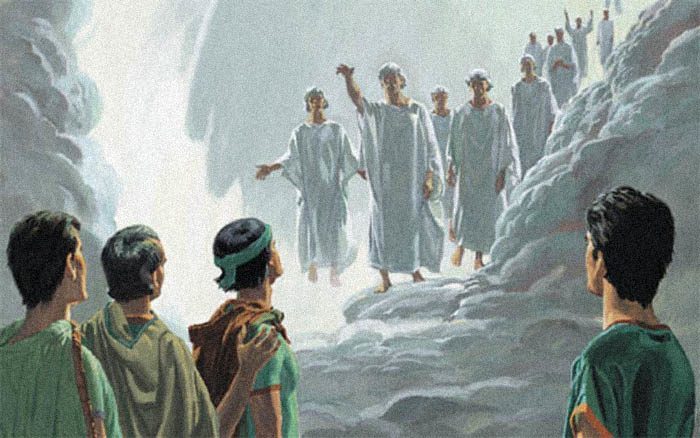
Throughout the scriptures, angels are sent to comfort, teach, protect, warn, and strengthen God’s children. Modern revelation confirms that their ministry continues today. Doctrine and Covenants 13:1 teaches that angels are involved in calling people to repentance and helping fulfill the Father’s covenants with His children.
We’ve been told by many of our Church leaders that the Lord has declared that He will have ‘a place prepared’ for His faithful Saints and that angels are engaged in helping accomplish His work.
Someday we may learn the identity of the angel who strengthened Jesus in Gethsemane. Until then, it is enough to know that Heavenly Father was perfectly aware of His Son’s suffering and provided the strength He needed to complete His divine mission.
That same principle offers hope to each of us. There are times when Heavenly Father does not immediately remove our burdens or answer our prayers as we hope. Instead, He often gives us the strength to endure, just as He strengthened His Son. That strength may come through the Holy Ghost, the scriptures, priesthood blessings, loving family members, faithful friends, or quiet spiritual impressions that remind us we are not alone.
The angel in Gethsemane remains unnamed, but his brief appearance points us to something far greater than his identity. It reminds us that heaven is aware of suffering, that God does not forget His children, and that His strength is available precisely when it is needed most. In the end, that message is far more important than knowing the angel’s name.
Gramps