

Question
Gramps,
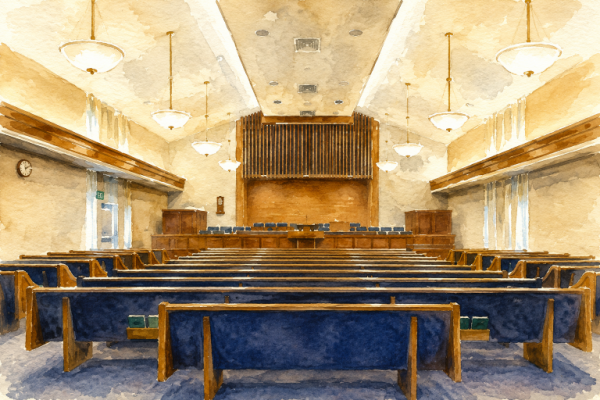
Why aren’t there paintings of Jesus Christ in a Latter-day Saint chapel?
Michael
Answer
Michael,
If you walk into many Christian churches, one of the first things you notice is artwork everywhere—large paintings of Jesus, statues of saints, stained glass windows depicting scenes from the Bible, and crosses prominently displayed near the pulpit. Then someone walks into a chapel belonging to The Church of Jesus Christ of Latter-day Saints and notices something different: the meetinghouse often feels simpler and more understated. Sometimes there may be artwork of Christ in hallways or classrooms, but not usually large paintings or elaborate depictions in the chapel itself, where sacrament meetings are held.
So why is that?
The answer has less to do with avoiding Jesus Christ and much more to do with how Latter-day Saints worship Him.
First, it is important to understand that Latter-day Saints absolutely believe in and worship Jesus Christ. In fact, the Savior is central to everything in the Church. The full name of the Church itself emphasizes this: The Church of Jesus Christ of Latter-day Saints.
The Book of Mormon teaches:
“We talk of Christ, we rejoice in Christ, we preach of Christ, we prophesy of Christ.” (2 Nephi 25:26)
Every sacrament meeting centers on Him. Prayers are offered in His name. Hymns praise Him. Talks teach His gospel. The sacrament itself is specifically designed to help members remember His atoning sacrifice every week.
Because of this, Latter-day Saints generally do not feel the need for elaborate visual reminders in the chapel itself. The focus is intended to remain on worship, ordinances, scripture, and the influence of the Holy Ghost rather than on visual imagery.
Latter-day Saint chapels are intentionally designed to be simple and reverent. The goal is to create an atmosphere where people can focus spiritually rather than on architecture or art.
Elder David A. Bednar explained:
“The ‘house[s] of prayer’ in which we gather on the Sabbath are meetinghouses and other approved facilities—holy places of reverence, worship, and learning.” “Be Still, and Know That I Am God”
That simplicity extends to the chapel itself. Rather than drawing attention to paintings, statues, or decorative symbols, the emphasis is placed on the sacrament table, the pulpit, and the ordinances performed there.
This approach is somewhat similar to early Christianity. The earliest Christian meeting places were often simple homes or modest gathering spaces rather than ornate cathedrals. Latter-day Saints generally seek to preserve the sense that worship should focus on Christ Himself rather than on physical representations of Him.
Another reason is that Latter-day Saints are cautious about allowing images to become the focus of devotion.
The Bible contains repeated warnings against idolatry. One of the Ten Commandments says:
“Thou shalt not make unto thee any graven image.” (Exodus 20:4)
Now, Latter-day Saints do not believe that all religious art is wrong. In fact, the Church uses artwork extensively in temples, visitors’ centers, manuals, magazines, websites, and even meetinghouse hallways. Paintings of Christ are very common throughout Church materials.
But there is a distinction between using artwork as a teaching tool and making imagery a central element of worship.
Elder Jeffrey R. Holland taught:
“Our first and foremost article of faith in The Church of Jesus Christ of Latter-day Saints is ‘We believe in God, the Eternal Father, and in His Son, Jesus Christ, and in the Holy Ghost.’” The Only True God and Jesus Christ Whom He Hath Sent
The Church wants the attention during worship services directed toward the Savior spiritually rather than toward artistic depictions of Him.
One meaningful detail many visitors may not immediately notice is that the sacrament table itself is intentionally designed to be the visual and spiritual center of the chapel.
In most Latter-day Saint chapels, the sacrament table is prominently placed at the front of the room, on the left-hand side of the stand (or on the right if you are facing the pulpit). Every week, the sacramental bread and water are blessed and passed to the congregation in remembrance of the Savior’s atoning sacrifice.
Rather than directing attention toward paintings, statues, or religious icons, the chapel layout encourages members to focus on the ordinance of the sacrament itself. For Latter-day Saints, the sacrament is more than a symbolic tradition—it is a sacred covenant renewal centered completely on Jesus Christ.
Elder Dallin H. Oaks taught:
“The ordinance of the sacrament makes the sacrament meeting the most sacred and important meeting in the Church.” Sacrament Meeting and the Sacrament
The sacrament table quietly teaches that the central focus of worship is not artwork about Christ, but remembering Christ through sacred ordinances.
In many Latter-day Saint chapels, the most visually prominent object is the sacrament table at the front of the room. That is intentional.
Each Sunday, members partake of the sacrament in remembrance of Jesus Christ’s body and blood. The ordinance itself becomes the symbolic reminder of Christ’s sacrifice.
Jesus taught during the Last Supper:
“This do in remembrance of me.” (Luke 22:19)
For Latter-day Saints, the sacrament ordinance is meant to be more spiritually powerful than any painting could be. Rather than looking at an image of Christ during worship, members participate in a covenant ordinance centered on Him.
Elder Russell M. Nelson taught:
“Sacrament meetings can be planned and conducted to help us remember the Lord and His Atonement.” Worshiping at Sacrament Meeting
Interestingly, some people assume Latter-day Saint buildings never contain artwork of Jesus at all, but that is not really true.
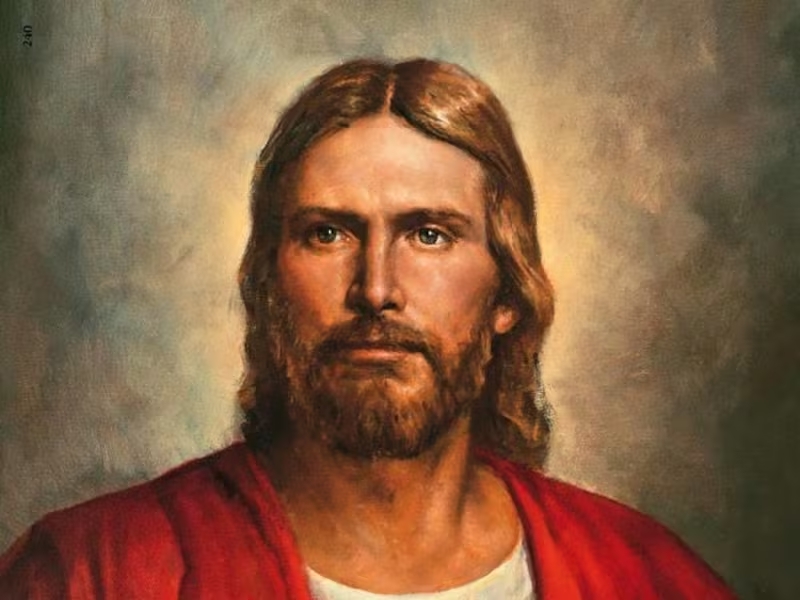
Many meetinghouses include paintings of Christ in foyers, hallways, classrooms, bishops’ offices, family history centers, or other areas of the building. The Church has increasingly used Christ-centered artwork in newer meetinghouses over the last several years.
One of the most recognizable paintings among Latter-day Saints is Del Parson’s “Christ in Red Robe.”
In recent years, Church leaders have encouraged members to focus even more openly and intentionally on the Savior. President Russell M. Nelson repeatedly emphasized using the full name of the Church to keep Jesus Christ central in members’ minds and conversations.
President Nelson said:
“If we as a people and as individuals are to have access to the power of the Atonement of Jesus Christ… we must clearly acknowledge Him as the source of that power.” The Correct Name of the Church
So the absence of large paintings in the chapel itself should not be interpreted as a lack of belief in Christ. If anything, modern Church efforts have become increasingly Christ-centered.
This question is often connected to another common observation: Latter-day Saints usually do not display crosses on their chapels either.
President Gordon B. Hinckley explained:
“The lives of our people must become the only meaningful expression of our faith and, in fact, therefore, the symbol of our worship.” The Symbol of Our Faith
Latter-day Saints deeply respect the sacrifice Jesus made on the cross. However, they tend to place greater emphasis on the living Christ—His Resurrection, His continuing ministry, and His role as the resurrected Savior.
Because of that, LDS worship tends to focus more on covenants, discipleship, and living the gospel than on physical symbols.
It is also worth noting that temples are somewhat different from regular chapels.
LDS temples often feature much more symbolic artwork, sacred imagery, murals, and carefully designed spaces intended to visually teach spiritual truths as well as to do so verbally. In visitors’ centers connected to temples, statues of Christ are also common, including replicas of Thorvaldsen’s Christus statue.
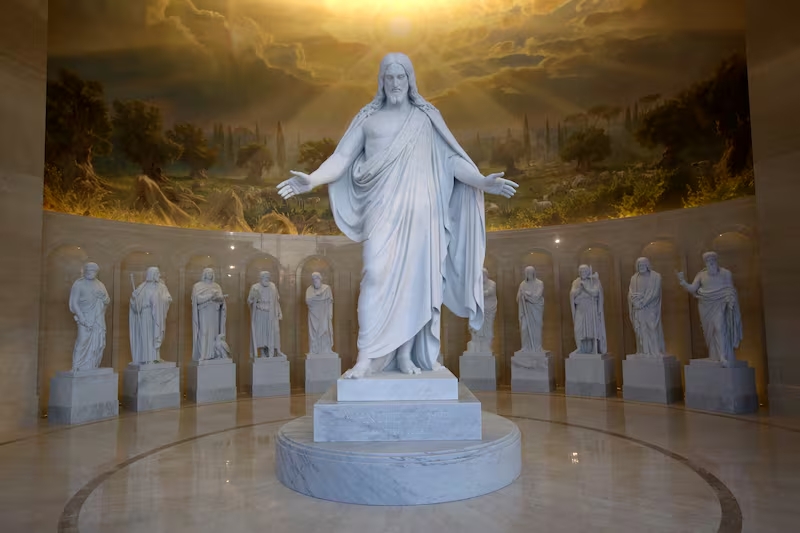
Regular meetinghouses, however, are designed primarily for weekly congregational worship and ordinances. Their simplicity reflects that purpose.
Ultimately, the lack of large paintings of Jesus Christ in a Latter-day Saint chapel is not because members are uncomfortable with the Savior or because He is unimportant. Quite the opposite.
Latter-day Saints believe Jesus Christ should be the center of worship, not merely a decoration within it.
They strive to remember Him through prayer, scripture study, ordinances, covenants, music, service, repentance, and discipleship. Rather than relying heavily on visual symbolism, LDS worship services are intended to invite the Holy Ghost to testify personally of Christ to the hearts of worshippers.
Moroni taught:
“By the power of the Holy Ghost ye may know the truth of all things.” (Moroni 10:5)
For Latter-day Saints, the most important image of Christ is not necessarily one hanging on a wall—it is the image of His character gradually reflected in the lives of His followers.
Gramps
Related Posts
 Was the idea that Blacks were less valiant in the pre-existence ever true?
 When did it become a practice to have members invited or assigned to give talks in Sacrament Meeting?
 How can the Church support vaccines knowing some are made from fetal matter?
 Why do you believe the Mormon religion has been growing? What is the appeal of the religion?