

Question
Gramps,
Why is there no mention of temple rites of any kind, (baptism for the dead, eternal marriage, becoming gods) spoken of in the Book of Mormon?
Brenda
Answer
Dear Brenda,
The answer, according to LDS doctrine, is actually more interesting than simply saying that the Nephites didn’t have temple ordinances. The first thing to understand is that the Book of Mormon is not silent about temples. In fact, temples appear throughout the record.
Nephi tells us that after his people separated from the Lamanites, he built a temple:
“And I, Nephi, did build a temple; and I did construct it after the manner of the temple of Solomon.” (2 Nephi 5:16)
Jacob also specifically says that he taught the people at the temple:
“Wherefore, I, Jacob, gave unto them these words as I taught them in the temple, having first obtained mine errand from the Lord.” (Jacob 1:17)
King Benjamin also gathered his people at the temple. Mosiah 2:1 says:
“The people gathered themselves together throughout all the land, that they might go up to the temple to hear the words which king Benjamin should speak.”
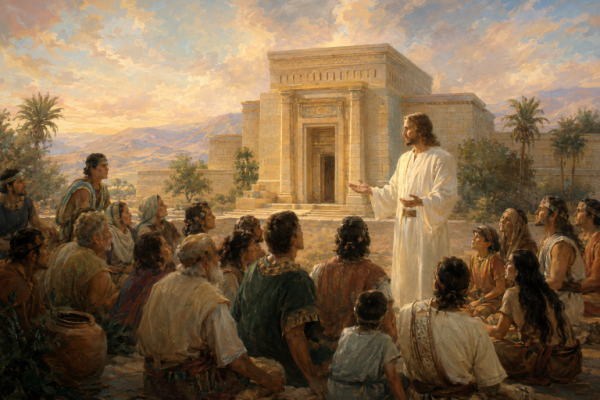
The most important temple scene appears in 3 Nephi. After the great destruction that accompanied the Savior’s death, the Nephites gathered around the temple in the land of Bountiful. It was there that the resurrected Jesus Christ appeared to them.
The scripture says:
“And now it came to pass that there were a great multitude gathered together, of the people of Nephi, round about the temple which was in the land Bountiful.” (3 Nephi 11:1)
So it would not be accurate to say that the Book of Mormon doesn’t mention temples. It clearly does. The real question is why it doesn’t describe the specific temple rites and ceremonies. One important reason is that the Book of Mormon was never intended to be a complete history of Nephite religious practices.
The title page itself describes the Book of Mormon as an abridgment of the record of the people of Nephi and the Lamanites. It also explains that one of its purposes is to convince people that “Jesus is the Christ, the Eternal God, manifesting himself unto all nations.”
Mormon repeatedly reminds us that he could not possibly include everything that had happened. For example, Mormon wrote:
“And there had many things transpired which, in the eyes of some, would be great and marvelous; nevertheless, they cannot all be written in this book.” (3 Nephi 5:8–9)
He then explains that the record could not contain even a hundredth part of what had happened among the people during those years. This is especially important when we consider what happened after the Savior appeared to the Nephites.
Jesus taught the people many things. In fact, Mormon says that Christ “expounded all things” to them, including things from the beginning of the world through the last days.
But Mormon then says:
“And now there cannot be written in this book even a hundredth part of the things which Jesus did truly teach unto the people.” (3 Nephi 26:1–9)
That gives us a pretty good explanation for why the Book of Mormon doesn’t answer every question we might have about Nephite worship. There was simply far more information available to the record keepers than what was included in the final record. But there is another important consideration: temple ordinances are sacred.
The current General Handbook of The Church of Jesus Christ of Latter-day Saints says:
“Since ancient times, whenever a faithful people has been on the earth, God has blessed them with temple ordinances and covenants.”
The Handbook then explains that whenever the Lord establishes His Church, He commands His people to build a house unto His name, where He reveals His ordinances and teaches the way of salvation.
It specifically cites 2 Nephi 5:16 as one example of this ancient temple pattern.
The Handbook also says:
“Temple ordinances and covenants are sacred. The symbols associated with temple covenants should not be discussed outside the temple.”
It then makes an important distinction:
“However, we may discuss the basic purposes and doctrine of temple ordinances and covenants and the spiritual feelings we have in the temple.”
This is significant because it means we shouldn’t necessarily expect the Book of Mormon to contain a detailed, step-by-step description of sacred temple ceremonies.
However, we also need to be careful not to make the opposite assumption. The Book of Mormon does not tell us that the Nephites performed the modern endowment ceremony exactly as it is performed today. It simply doesn’t give us enough information to make that claim. Latter-day Saint doctrine teaches that temple worship is ancient, but that specific ordinances have been restored and revealed in the latter days.
The Church’s current Gospel Topics material explains:
“God has always commanded His people to build temples.”
It also explains that ancient and modern temples share many similarities, and that modern temples are places where Church members make special covenants and participate in sacred ordinances.
So we can safely say that temple ordinances and covenants have an ancient foundation in LDS doctrine. What we cannot safely say is that every ancient temple used precisely the same ceremony, wording, or procedure used in modern temples.
There is another fascinating point in the Book of Mormon itself. Jacob tells us that when he was instructed to write on the small plates, he was supposed to record only the things that were “most precious.” Jacob explained that he had been commanded to write on the plates “a few of the things which I considered to be most precious.” (Jacob 1:1-4)
In other words, the record keepers were making choices about what was important enough to preserve. And what did they emphasize? Again and again, they emphasized Jesus Christ, His Atonement, faith, repentance, covenants, revelation, and the gospel. That fits perfectly with the stated purpose of the Book of Mormon.
President Ezra Taft Benson explained:
“The major mission of the Book of Mormon, as recorded on its title page, is ‘to the convincing of the Jew and Gentile that Jesus is the Christ, the eternal God, manifesting himself unto all nations.’”
He continued:
“Over one-half of all the verses in the Book of Mormon refer to our Lord.”
The purpose of the Book of Mormon, therefore, helps explain why the record focuses so heavily on Christ and His gospel rather than giving us a comprehensive description of Nephite religious ceremonies.
There is also something very interesting about the way the Savior Himself taught the Nephites.
When Jesus appeared at the temple in Bountiful, He taught them extensively. He taught them about faith, repentance, baptism, the Holy Ghost, prayer, the sacrament, the gospel, covenants, and the gathering of Israel.
But Mormon did not record everything Jesus taught. In fact, Mormon specifically tells us that what he recorded was only a “lesser part” of what Jesus taught and that the plates contained much more.
That is an important reminder when we ask why something isn’t in the Book of Mormon. Absence from the record doesn’t necessarily mean absence from Nephite religious practice. It may simply mean that the information wasn’t included in the abridgment.
So, why is there no detailed mention of temple rites in the Book of Mormon? From an LDS perspective, there are several reasonable answers.
First, the Book of Mormon is an abridged record, not a complete history. Mormon tells us directly that it contains only a tiny portion of what actually happened.
Second, the primary purpose of the Book of Mormon is to testify of Jesus Christ and teach His gospel, rather than provide a complete description of Nephite religious ceremonies.
Third, temple ordinances are sacred, and the Church teaches that some aspects of temple worship are not to be discussed outside the temple.
And finally, we shouldn’t assume that ancient Nephite temple practices were identical in every detail to modern temple ordinances. The scriptures clearly establish that the Nephites had temples, but they don’t give us enough information to reconstruct all of their temple worship.
What the Book of Mormon does make very clear is that temples mattered.
Nephi built one.
Jacob taught in one.
King Benjamin gathered his people at one.
And when the resurrected Savior came to the Nephites, He chose a temple as the setting for His appearance.
That last detail is especially meaningful.
The Book of Mormon may not tell us everything that happened inside Nephite temples, but it gives us a powerful witness that the temple was an important part of the Lord’s relationship with His covenant people.
In the end, perhaps the better question isn’t, “Why doesn’t the Book of Mormon tell us everything about temple rites?” Maybe it’s, “What does the Book of Mormon tell us about the purpose of temples?”
And on that question, the record gives us quite a lot: temples were places where God’s people gathered, prophets taught, worship took place, and ultimately, where the resurrected Jesus Christ Himself appeared to His people.
Gramps
Related Posts
 Is marriage for eternity in the Mormon temple a requirement for exaltation in the celestial kingdom?
 Was Shem the great high priest Melchizedek?
 What ever happened to the Ark of the Covenant?
 If I have a divorce after a temple marriage but do not have the sealing cancelled, will I be sealed to my ex forever even though we have parted company now?