
Question
Gramps,
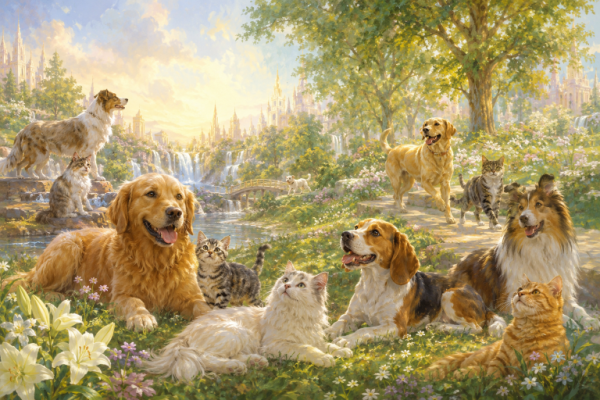
Pets and the hereafter, and our association with them, are a sensitive thing for my soul. With all due respect to family and friends, I have deep love and bonds with my pets. Primarily Dogs. I, and others, have publicly stated that “I would rather be with my pets than people.” They are loyal, their love is unconditional, they are protective, and they live their lives with an extreme sense of sovereignty and dedication. If Heaven doesn’t allow pets, I’m not excited to reside there! Family, along with my furry friends, would be my Heavenly home. Why would a loving Father deny his children the joy of separation from loved creatures?
Michael
Answer
Michael,
One of the most tender questions many Latter-day Saints ask is, “Will I see my pets again after this life?” Anyone who has loved a faithful dog, a gentle cat, a horse, or another cherished animal knows that these companions often become part of the family. When they pass away, the separation can be deeply painful.
This naturally leads to another question: If Heavenly Father is loving and merciful, why would He deny His children the joy of being reunited with creatures that brought comfort, happiness, and companionship during mortality?
While the restored gospel does not provide a detailed explanation of exactly how animals fit into the eternal worlds, it does offer several truths that provide hope and comfort.
The scriptures teach that animals are part of God’s creations and were given for the benefit and happiness of His children.
The Lord declared:
“For behold, all things which come of the earth, in the season thereof, are made for the benefit and the use of man, both to please the eye and to gladden the heart” (Doctrine and Covenants 59:18).
Animals enrich our lives in countless ways. They teach loyalty, trust, affection, and responsibility. They bring joy into homes and often provide comfort during difficult times.
The scriptures also show God’s concern for animal life. Noah was commanded to preserve animals in the ark. The Lord expressed concern for the animals of Nineveh in the book of Jonah. Throughout the scriptures, animals are portrayed as valuable parts of God’s creations.
Because God is the Creator of all life, many Latter-day Saints believe that His love extends to all living things He has made.
One of the most powerful teachings of the Restoration is that animals are more than mere biological creatures.
Doctrine and Covenants 77 discusses John’s vision of heavenly beings described in the book of Revelation. The Lord explained that these creatures represented real living beings in heaven and referred to “the happiness of man, and of beasts” (D&C 77:2-3).
The Prophet Joseph Smith expanded on this doctrine. Speaking about John’s vision, he taught:
“John saw every creature that was in heaven,—all the beasts, fowls and fish in heaven,—actually there, giving glory to God.”
Joseph Smith also clarified that these creatures were not merely symbolic:
“But John saw the actual beast in heaven, showing to John that beasts did actually exist there.”
These teachings are significant because they establish that animals exist in heavenly realms and retain identity beyond mortality.
Perhaps the most remarkable statement from Joseph Smith on this subject is the following:
“John learned that God glorified Himself by saving all that His hands had made, whether beasts, fowls, fishes or men; and He will glorify Himself with them.”
This statement suggests that God’s redemptive work reaches far beyond humanity alone. His creations are important to Him, and His purposes include all that He has made.
This does not mean animals receive salvation in the same sense that humans do. They are not accountable moral agents as we are. However, it does indicate that they have an enduring place in God’s eternal creations.
One of the clearest teachings on this subject comes from President Joseph Fielding Smith.
He taught:
“The animals, the fishes of the sea, the fowls of the air, as well as man, are to be recreated, or renewed, through the resurrection, for they too are living souls.”
This statement is profound. It teaches that the resurrection made possible through Jesus Christ extends to animal life as well.
The Doctrine and Covenants also speaks of a future renewal of creation:
“For all old things shall pass away, and all things shall become new, even the heaven and the earth, and all the fulness thereof, both men and beasts” (Doctrine & Covenants 29:24).
Because animals will participate in this renewal, many Latter-day Saints find hope that beloved pets are not simply lost forever.
At this point, it is important to distinguish between revealed doctrine and faithful hope.
The Church has never officially declared that every pet will be reunited with its owner in the next life. No revelation has provided those details. However, the doctrines we do have point in a hopeful direction.
We know that animals have spirits. We know that animals exist in heaven. We know that animals are part of God’s creations. We know that animals will be renewed through the resurrection. Because of these truths, many faithful members conclude that it would not be surprising if beloved pets continue to exist as individual creations of God.
The question that often touches people’s hearts most deeply is this: Why would a loving Father take them away forever?
The Book of Mormon teaches:
“Men are, that they might have joy” (2 Nephi 2:25).
The purpose of God’s plan is not to reduce joy but to increase it. The celestial kingdom is described as a place of fullness, happiness, peace, and eternal relationships.
Many members reason that if a beloved animal brought innocent joy, companionship, and comfort in mortality, a loving Heavenly Father understands those feelings perfectly.
While we cannot say with certainty exactly how these relationships will continue, it seems consistent with God’s character that He would not needlessly withhold sources of righteous happiness from His children.
The God who notices every sparrow surely understands the grief that accompanies the loss of a cherished pet.
The restored gospel does not provide a definitive answer about whether every pet will be reunited with its owner. However, it does teach several truths that offer great comfort.
Animals are creations of God. They have spirits. They exist in heavenly realms. They are included in God’s purposes. Through the power of Jesus Christ’s Resurrection, they will be renewed and restored.
For that reason, many Latter-day Saints look forward with hope.
Heaven is not a place where good things are lost forever. It is a place where God’s work of restoration reaches its perfect fulfillment. While we await further revelation, we can trust that Heavenly Father loves His creations, remembers them, and will ultimately provide far greater happiness than we can presently imagine.
For those who have loved and lost a faithful animal companion, that hope can be a source of genuine peace.
Gramps