

Question
Dear Gramps,
How does the Lord soften the hearts of men ( as often referenced in the Book of Mormon) without interfering with their agency?
Chelsea
Answer
At the core of The Church of Jesus Christ of Latter-day Saints’ doctrine is agency—often termed “moral agency.” Moral agency doesn’t mean that we are free to do whatever we please, but rather it is the divinely granted ability to choose good or evil and to be held accountable for our choices.
Agency also does not mean that we are free from all influence. We are constantly subject to powerful pulls and persuasions—both divine and worldly. The Book of Mormon teaches that we are “free to choose liberty and eternal life, through the great Mediator of all men, or to choose captivity and death, according to the captivity and power of the devil.” (2 Nephi 2:27) Thus, while surrounded by influences, we alone are responsible for our choices. Brigham Young said this about the subject:
“You are aware that many think that the Devil has rule and power over both body and spirit. Now, I want to tell you that he does not hold any power over man, only so far as the body overcomes the spirit that is in a man, through yielding to the spirit of evil. The spirit that the Lord puts into a tabernacle of flesh, is under the dictation of the Lord Almighty; but the spirit and body are united in order that the spirit may have a tabernacle, and be exalted; and the spirit is influenced by the body, and the body by the spirit.
“In the first place the spirit is pure, and under the special control and influence of the Lord, but the body is of the earth, and is subject to the power of the Devil, and is under the mighty influence of that fallen nature that is of the earth. If the spirit yields to the body, the Devil then has power to overcome the body and spirit of that man, and he loses both.
“Recollect, brethren and sisters, every one of you, that when evil is suggested to you, when it arises in your hearts, it is through the temporal organization. When you are tempted, buffeted, and step out of the way inadvertently; when you are overtaken in a fault, or commit an overt act unthinkingly; when you are full of evil passion, and wish to yield to it, then stop and let the spirit, which God has put into your tabernacles, take the lead. If you do that, I will promise that you will overcome all evil, and obtain eternal lives. But many, very many, let the spirit yield to the body, and are overcome and destroyed.” (Discourses of Brigham Young, p. 69-70 as taken from the Book of Mormon Student Manual, 1981 ed., p. 73-4)
God’s respect for moral agency also shapes how He interacts with us. As explained in the Doctrine and Covenants: “No power or influence can or ought to be maintained by virtue of the priesthood, only by persuasion, by long-suffering, by gentleness and meekness, and by love unfeigned” (D&C 121:41). God will call, persuade, direct, and bless with wisdom and light, but He will never force the human mind. In this pattern, even the compelling experiences of visions, visitations, or dramatic divine interventions never take away the individual’s agency to choose how to respond.
Vaughn J. Featherstone said:
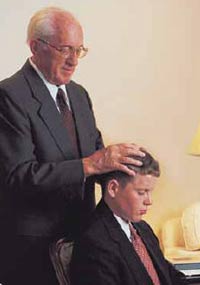
Gentleness is a word the Lord uses to describe a necessary trait for one who would use the priesthood. Usually we think of gentleness as a womanly trait. Gentleness is inoffensive, is kind, and has a softening way about it. Think of a gentle touch until you can almost feel it. In leadership, often a gentle touch creates discipleship whereas an iron hand creates rebellion. When we perform the ordinances of the priesthood-such as administering to the sick, giving blessings, ordaining or setting apart, baptizing, or preparing the sacrament-physical and spiritual gentleness is always called for.
Meekness is equally necessary. Those who are meek are absolutely submissive to God. They are teachable and have humble hearts. They are modest in their dress, speech, and service. The meek readily take on the servant-leader role. Righteousness and wisdom may come from any source, even from the lowliest among those whom they lead, and the meek acknowledge and accept it. Meekness causes us to focus on principles, that is, what is right and not who is most influential. The meek feel no need to receive credit; rather they desire to give it to those who may need it.
Love unfeigned suggests genuineness. There is no deceit, ploy, self-serving, spurious attitude in the person whose love is unfeigned. This is the type of love leaders must have. Those who exercise unfeigned love are authentic, genuine, natural, sincere, and honest. They do not flatter, nor do they distort. They are, as someone has said, “all wool and a yard wide.”
To be a leader with unfeigned love has such great consequences that becoming one is in itself a supreme motivator. The Savior represented this principle in every act. Such love is a rare quality even in the Church, but it is indispensable to righteously functioning in the priesthood. (The Incomparable Christ: Our Master and Model [Salt Lake City: Deseret Book Co., 1995], 127
For example, when the angel appeared to Alma the Younger, the resulting change was not from compulsion but was a direct answer to the prayers of Alma’s father and others, while still preserving Alma’s freedom to choose how to respond—just as Laman and Lemuel encountered an angel but did not ultimately choose faithfulness.
If God will not force a change of heart, how then does genuine—and often profound—internal transformation occur? The answer lies in the gospel process of faith in Jesus Christ, sincere repentance, and the influence of the Holy Spirit.
The Book of Mormon and modern prophets alike teach that a true “change of heart” comes when someone turns from worldliness to godliness through this process. As Samuel the Lamanite declared, “faith and repentance bring a change of heart” (Helaman 15:7–8). Steps on this path include:
1. Exposure to the teachings of Christ, the scriptures, and the influence of the Holy Spirit invites an individual to reconsider their current state and desires.
2. As people choose to believe—however tentatively—this opens a door for greater light and understanding.
3. Turning away from sin and sincerely striving to align one’s life with Christ allows the healing power of the Atonement to begin to work within.
4. Over time, persistent faith and repentance lead to sanctification—old temptations lose their power and former sins become repugnant rather than appealing.
It is crucial to recognize that, contrary to what some might suppose, this process does not happen instantly, nor does it completely erase all tendencies toward sin.
As President Ezra Taft Benson famously said: “When you choose to follow Christ, you choose to be changed…The Lord works from the inside out. The world works from the outside in. The world would take people out of the slums. Christ takes the slums out of people, and then they take themselves out of the slums. …The world would shape human behavior, but Christ can change human nature.
The Atonement of Jesus Christ is the supreme enabler of changed hearts, for it is only through His sacrifice, love, and grace that the miracle of transformation occurs. As the Book of Mormon states, Christ “will take upon him the pains and the sicknesses of his people. … He will take upon him their infirmities, that his bowels may be filled with mercy, according to the flesh, that he may know according to the flesh how to succor his people according to their infirmities” (Alma 7:11-12). Only such love—unconditional, personal, and far-reaching—can motivate lasting repentance and soften the most stubborn hearts.
Scriptures and history provide many powerful illustrations of this principle. Alma the Elder’s years of prayers for his rebellious son ultimately resulted in a visit from an angel, but Alma the Younger still had to choose, as all do, whether to accept or reject the invitation to change. Similarly, Saul’s dramatic encounter on the road to Damascus left him with increased knowledge and a stark choice—but he still freely decided to follow the Savior.
Influence is not compulsion. God may remove obstacles or provide opportunities, but ultimate responsibility for choices remains with the individual. The same is true in how God delivers people from bondage or removes evil from oppressive situations. He may change the conditions or curtail the action, but each person’s agency remains untouched. As long as there is an opportunity to be “enticed by opposites,” true moral agency is respected.
Gramps