
Question
Gramps,
What is the message being said in Section 6?
Christina
Answer
Christina,
In the spring of 1829, Oliver Cowdery arrived in Harmony, Pennsylvania, eager to assist Joseph Smith in translating the golden plates—an ancient record that would become The Book of Mormon. Though he possessed great faith, Oliver, like many, grappled with private doubts and uncertainty.
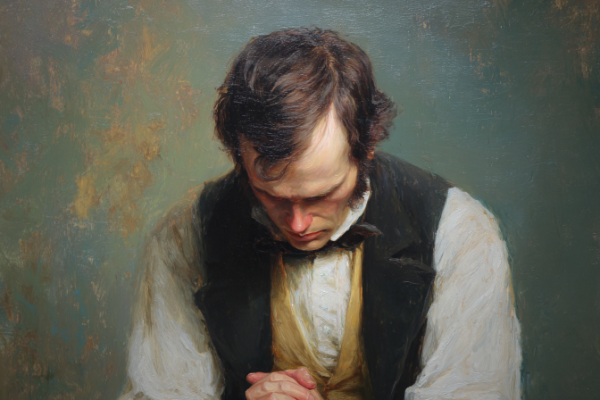
Oliver’s approach was methodical and sincere. Before setting out to meet Joseph Smith, Oliver sought confirmation through earnest prayer. According to later accounts, these prayers had a profound spiritual impact, leading him to feel that his course was right. Even so, upon arrival and amidst the complexities of translation and spiritual gifts, Oliver’s uncertainties lingered. Would his faith be enough? Could he trust the process and the Prophethood of Joseph Smith?
It was in this atmosphere that Doctrine and Covenants section 6 was received. The revelation is framed as a direct response to Oliver’s hidden concerns—sometimes unarticulated, sometimes deeply personal. What makes the revelation remarkable is not merely the information it provides but the way in which the Lord addresses Oliver’s heart and mind with specificity and gentleness.
Doctrine and Covenants 6 is often cited as a masterpiece of divine empathy. The Lord does not merely issue commands or withhold answers; instead, He acknowledges Oliver’s secret prayers and desires, bringing comfort and personalized assurance. According to Steven Harper, “[Oliver] had kept the circumstance entirely secret, and had mentioned it to no one; so that after this revelation was given, he knew that the work was true, because no being living knew of the thing alluded to in the revelation, but God and himself.”
The revelation gently confronts Oliver’s fears, instructing, “Look unto me in every thought; doubt not, fear not.” This is not a casual command but a lifeline extended to those wrestling with intense private anxieties. The Lord further declares that He is granting assistance not arbitrarily or capriciously, but in answer to sincere prayers—both Joseph’s and Oliver’s. According to the retelling, “He was answering Joseph’s prayer for help before he voiced it. He came to Oliver’s aid over and over, with experiences perfectly adapted to assure Oliver that He is Jesus Christ, the Son of God, and that if Oliver will choose to look unto Him in every thought, he need neither doubt nor fear.”
This exchange reveals several theological cornerstones of the Church:
God’s Loving Omniscience: The ability to discern and respond to individual needs and desires, even those not outwardly expressed.
The Legitimacy of Seeking Answers: The process of asking questions—far from being a sign of weakness—is portrayed as both natural and divinely encouraged.
Revelation as Reassurance: Divine answers are given not to stifle inquiry but to provide confidence, personal peace, and deeper conviction.
The Church has, since its inception, emphasized that the pattern seen in Oliver’s experience is available to all sincere seekers. In modern teachings and practice, personal revelation—meaning direct communication from God through the Holy Spirit—is considered one of the defining blessings of the discipleship experience. For members, this includes everything from small daily decisions to major life callings.
Personal revelation is portrayed as a process where concerns, doubts, or questions naturally arise as part of spiritual growth. When individuals, like Oliver, turn to the Lord in prayer, they are encouraged to expect answers in ways suited to their unique circumstances and sensitivities. Leaders continually teach that “if Oliver [or any disciple] will choose to look unto Him in every thought, he need neither doubt nor fear.” In this light, revelation is a relationship—a dynamic, ongoing conversation between God and His children.
In subsequent years, official Church publications, talks, and manuals reinforce this message. They cite examples of members finding specific guidance, comfort, or conviction through sincerely sought answers. The progression moves from uncertainty to reassurance—from “doubts and fears” to confidence and action. There is now a much-quoted saying by Elder Dieter F. Uchtdorf that seems appropriate here: “Doubt your doubts, before you doubt your faith.”
Moreover, the experiences of Oliver Cowdery and others from the early history are presented not just as ancient history, but as a template; the timing, delivery, and personalized wording of divine messages remain ever-relevant. Church members are taught to view themselves as potential recipients of the same loving, omniscient guidance that guided Oliver’s journey.
While doubt has often been stigmatized in religious contexts, the approach modeled in Doctrine and Covenants 6 is different. The presence of fear, uncertainty, and even disillusionment is acknowledged—even expected. What matters is what believers do with those feelings: rather than suppressing questions, the faithful are invited to “ask, seek, and knock,” trusting that answers are available through divine means.
For Oliver, the culmination of this process was a deepened faith—not only in the work he was assisting with, but in God’s individualized awareness of and concern for him. After receiving answers that penetrated to the core of his prior experiences (“Joseph had told him secrets of his life that he knew could not be known to any person but himself”), Oliver’s testimony became unshakable. This mirrors the process by which modern Saints are encouraged to “anchor” themselves—not in infallible certainty about every doctrine or event, but in a personal, living relationship with Jesus Christ.
This theology of continuing revelation sets the Church apart in significant ways. In an age where many feel disconnected from institutional religion, the invitation to seek personal guidance, reassurance, and direction is a potent antidote to alienation and doubt. It signals that God is not remote, arbitrary, or dismissive, but engaged, loving, and infinitely approachable.
The experience of Oliver Cowdery, as illuminated in Doctrine and Covenants 6, is not simply a footnote in Church history. It embodies the way The Church of Jesus Christ of Latter-day Saints views revelation, faith, and the loving, omniscient nature of God. The Lord’s response to Oliver’s secret prayers and unspoken doubts offers a timeless model: honest questions are welcomed, and divine answers are tailored to individual needs.
The invitation remains open: approach God with sincere questions. Trust His awareness of your hidden fears and unspoken needs. In doing so, you may discover, as Oliver did, that divine reassurance is both possible and profoundly personal.
Gramps