
Question
Dear Gramps,
What does it mean t be a pure Israelite?
Thank you,
M.S.E.
Answer
M.S.E.,
The words “Jew” and “Gentile” originate in ancient Israelite history. Biblically, a “Jew” refers to descendants of the kingdom of Judah, while “Gentile” means anyone not of the house of Israel. However, as the Book of Mormon and modern Church leaders clarify, these distinctions are broader than genealogy alone.
In the language of the Book of Mormon, “Jews” are broadly defined as “those descended from the inhabitants of the kingdom of Judah at the time Lehi left Jerusalem, regardless of whether individuals might have had ancestors not of the tribe of Judah.” Even someone from another tribe, but living in Jerusalem in 600 B.C., could be called a Jew for practical purposes.
Conversely, “Gentile” in a religious sense is any nation or people not belonging to the ancient house of Israel. In common Latter-day Saint parlance, this definition shifts: after joining the Church, members are said to belong to Israel—either by literal descent or by adoption, as revealed in their patriarchal blessing. Those outside the covenant—those who have not united themselves to Abraham’s family through baptism and covenant—remain “Gentile” in this context.
Many picture ancient Israel as a distinct, untainted bloodline. Yet, as both scripture and modern scholarship confirm, the Israelites intermarried widely with the surrounding peoples—Canaanites, Moabites, and even Philistines. Over the centuries, those who joined Israel were absorbed, regardless of their origin, illustrating that kinship in Israel had as much to do with covenant and association as with DNA. Historian John Bright observed:
We are not to suppose that the entity we call Israel was formed and held together in the face of adversity exclusively, or even primarily, through ties of blood kinship… There is abundant evidence that not all Israelites were in fact related one to another by blood.
Thus, “Jew” and “Gentile” are as much spiritual designations as they are genealogical ones.
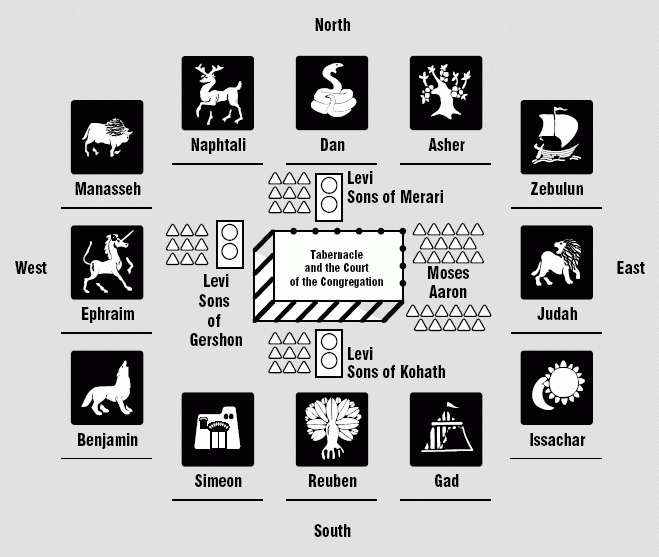
One of the most distinctive teachings of the Church is that each member receives, through their patriarchal blessing, a declaration of their lineage in the house of Israel—often specifying a tribe, such as Ephraim or Manasseh. This declaration can reflect either literal blood descent or adoption into Israel.
No one today is a “pure Israelite” by blood, except perhaps Jacob (Israel) himself. His children—though called the “twelve tribes”—were only half Israelite, as they shared mothers from other nations. By the time of the Exodus, centuries later, these proportions had diminished even further due to intermarriage. Later dispersions and the mingling with population after population mean that the genetic “blood of Israel” is present in many more people than previously suspected, but rarely in high concentrations.
President Boyd K. Packer summarized Church teachings on this point:
In giving a blessing the patriarch may declare our lineage, that is, that we are of Israel, therefore of the family of Abraham, and of a specific tribe of Jacob. In the great majority of cases, Latter-day Saints are of the tribe of Ephraim, the tribe to which has been committed the leadership of the Latter-day work.
Whether by birth or through the vast, often mysterious movements of peoples and genealogies, Church members are frequently counted as literal descendants of Israel, especially the tribe of Ephraim.
But what if a person is not a literal child of Abraham? The power of the Abrahamic covenant is that it extends to all who embrace the gospel. The Lord can raise up seed unto Abraham from stones if necessary (see Matthew 3:9), and the New Testament repeatedly emphasizes that true descendants do the works of Abraham, irrespective of bloodline. In the Church, those not actually descended from Israel are spiritually adopted—grafted—into the family of Abraham, Isaac, and Jacob, as Paul discusses in Romans 8:15-17.
This adoption is not symbolic only. It entitles the convert to all rights, blessings, and privileges, as if they were natural descendants:
If anyone joins the…Church, who is not a lineal descendant of one of the tribes of Israel, is adopted into the house of Israel and has the same status as though he were a literal descendant. Those who join other Christian churches have no such promise made to them, either by their own church authorities or anyone else. Therefore, they have no claim to be descendants of Abraham, Isaac, and Jacob. So they would naturally be designated as Gentiles, i.e., as not pertaining to the house of Israel.
Joseph Smith further clarified:
…the effect of the Holy Ghost upon a Gentile, is to purge out the old blood, and make him actually of the seed of Abraham. That man that has none of the blood of Abraham (naturally) must have a new creation by the Holy Ghost.
Thus, every member of the Church is considered part of Israel—either by descent or adoptive covenant.
For many, the declaration of tribal lineage in a patriarchal blessing is a curiosity: What difference does it make to know my tribe? Why does it matter?
The promise to Abraham was that all nations would be blessed through his seed (Genesis 22:17-18). But the blessing was not just for this life:
17 That in blessing I will bless thee, and in multiplying I will multiply thy seed as the stars of the heaven, and as the sand which is upon the sea shore; and thy seed shall possess the gate of his enemies;
18 And in thy seed shall all the nations of the earth be blessed, because thou hast obeyed my voice.
Among the great blessings given to Abraham…is included the astounding blessing that all of those who enter the celestial kingdom of God will be counted as his descendants…If anyone who is not of the lineage of Abraham joins The Church of Jesus Christ of Latter-day Saints…that person is adopted into one of the twelve tribes of Israel. The government of the kingdom of heaven in the eternities will undoubtedly take into account the various tribes of Israel. Thus, in that realm, each tribe may have particular responsibilities.
While specific tribal responsibilities in the afterlife are not yet fully revealed, the principle is clear: the family of Israel is spiritual more than it is genetic, and participation in the covenants entitles one to the associated blessings and, potentially, special duties.
The Book of Mormon and modern revelation teach that Israel, even when scattered and mixed, is to be gathered, both spiritually and physically, in the last days. As Elder Bruce R. McConkie explained:
The gathering of Israel consists of joining The Church of Jesus Christ of Latter-day Saints and coming to a knowledge of the true God and of Jesus Christ whom he has sent.
Every Christian who is baptized and receives the Holy Ghost, according to Church teaching, becomes an Israelite—no longer a Gentile—no matter their ancestry.
This doctrine unites believers—regardless of background—in an eternal family, bound by covenant more than by genetics. The question ceases to be “Are you Jew or Gentile?” and becomes, “Are you part of the covenant family of God, willing to do the works of Abraham and inherit his promises?” In that spirit, all are invited to gather, belong, and receive every blessing promised to the faithful descendants of Abraham.
Gramps