
Question
Gramps,
What is the purpose of the 12 tribes in the context of the Plan of Salvation? Do tribes tell us something about our creation age? Or the place we lived in our premortal life?
Abdias
Answer
Abdias,
In the theology of The Church of Jesus Christ of Latter-day Saints, belonging to a tribe of Israel is not merely a badge of lineage but represents a connection to the ancient Abrahamic covenant. As outlined in Church teachings, those who join the Church, whether by birthright or conversion, are either literal descendants of one of Israel’s tribes or adopted into that lineage. A stake patriarch—an ordained ecclesiastical leader—may declare by inspiration to which tribe a member belongs in the course of a patriarchal blessing.
This declaration, however, should not be misunderstood as conferring special status or duties in mortal life that trump the universal call to righteousness. All of those who enter the celestial kingdom of God will be counted as [Abraham’s] descendants…anyone who is not of the lineage of Abraham…that person is adopted into one of the twelve tribes of Israel” through their faithfulness in the gospel. The Abrahamic covenant, then, expands to embrace all who accept gospel ordinances, making tribal membership both an identity marker and a sign of having entered into a covenant with God.
Why, then, is it important to know one’s tribe? Church leaders and writers suggest that the greater significance likely lies in the next life rather than in this mortal life. Prophetic statements suggest that in the government of the heavenly kingdom, the various tribes may have distinct responsibilities, reflecting patterns of organization and stewardship that date back to Israelite tradition. While concrete doctrinal details about the future role of the tribes are limited, this connection shows the eternal scope of God’s promises and the ongoing gathering of His people.
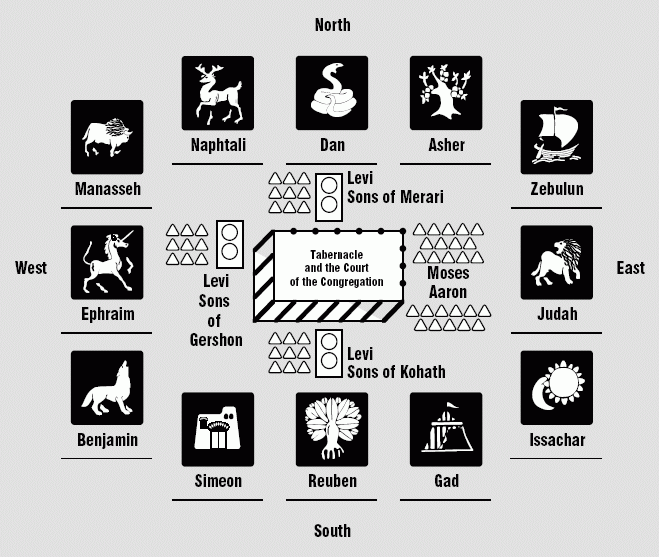
Numbers, particularly twelve, play a recurring and powerful role in biblical and Latter-day Saint thought. Twelve is repeatedly associated with divine government and priesthood. The Old Testament describes how Jehovah established His covenant nation among the twelve tribes—descendants of the sons of Jacob (Israel). Interestingly, the scriptural record is not entirely rigid: Joseph’s double-portion blessing is split among his sons Ephraim and Manasseh, and in various tribal lists, one son might be omitted to preserve the count at twelve.
This use of twelve extends to Christ’s calling of twelve apostles, setting a precedent for leadership and priesthood governance. Within the context of The Church of Jesus Christ of Latter-day Saints, apostles, presidents, and other leaders operate in quorums and bodies often patterned after the organization of ancient Israel—a divine order perpetuated on earth and anticipated to continue into eternity.
But the symbolism is not arbitrary. Twelve represents wholeness and organization under God’s authority. Twelve (12) is associated with the Government of God, or Priesthood…Jehovah built his covenant nation upon the foundation of 12 tribes. The persistence of this pattern across dispensations reflects God’s consistency and the enduring nature of His promises. It is within this divine governmental order that the importance of tribal identity yet endures.
For members of the Church, the narrative of Israel’s twelve tribes culminates in the prophesied latter-day gathering. This theme is embedded in foundational Church scriptures and Articles of Faith, such as the tenth, which affirms belief “in the literal gathering of Israel and in the restoration of the Ten Tribes.”
This gathering, however, is understood in two distinct but related senses. First is the spiritual gathering, which occurs as individuals from around the world join the Church and are adopted into the house of Israel—often receiving lineage declarations by revelation, as described earlier. This process is underway wherever people accept the “good news” and the sacred ordinances restored to the earth in this dispensation.
Second is the prophetic restoration of the ten lost tribes, a subject of considerable scriptural intrigue and expectation. Ancient Israel split into two kingdoms, with ten tribes carried away by the Assyrians and later scattered across the world. Modern Church leaders and scholars have reflected that while many of their descendants are now scattered and assimilated among the nations, a main body of the ten tribes remains together, awaiting a miraculous return. Notably, the Savior Himself referred to this group in 3 Nephi 17:4, stating that the ten tribes “are not lost unto the Father, for he knoweth whither he hath taken them.” Furthermore, the Book of Mormon, 2 Nephi 29:13, suggests that this group will produce their own records as evidence of their continued existence as a people.
The restoration of these tribes is placed in close connection with the Lord’s return. Scriptures and prophetic interpretation suggest that the ten tribes will likely return as a group, recognized as such, bringing with them sacred records and participating in the ushering in of the millennial reign of Christ. This event surpasses the ancient exodus in magnitude and fulfills the dream of a fully gathered Israel.
But even for the so-called “lost” tribes, their dispersion has not ended God’s purposes. As Latter-day Saint scholar B.H. Roberts explained, over the centuries, the blood of Israel became intermingled among all nations, fulfilling the prophetic assurance that Israel would be sifted among the people of the earth. Today, many supposed Gentiles may, in fact, have Israelite ancestry—literal descendants unaware of their heritage until called by the Spirit to gather in modern Zion.
The practical effect of knowing one’s tribe is both deeply personal and profoundly communal. For members of The Church, receiving a patriarchal blessing that indicates lineage serves as a reminder to fulfill sacred responsibilities, to participate actively in the gathering of Israel, and to build up Zion in preparation for the Second Coming. It also contextualizes personal identity within a vast, divinely orchestrated story that stretches from Abraham through Jacob, Christ, and into our own day.
More broadly, this awareness fosters unity among Church members, as all are embraced as part of the covenant Israel—whether by birth or adoption—each with a unique place and purpose in God’s unfolding plan. As the gathering progresses, the diverse descendants of Israel are brought together in anticipation of a time when distinctions may again organize service and stewardship under the governance of God, both on earth and, as many anticipate, in eternity itself.
Gramps