
Question
Gramps,
It says in Exodus 33:20 that no one can see God’s face and live. This confuses me about how Joseph Smith saw God.
Colleen
Answer
Colleen,
One of the verses that often confuses people is Exodus 33:20. In that passage, the Lord tells Moses:
“Thou canst not see my face: for there shall no man see me, and live.”
At first glance, that seems pretty straightforward. If no one can see God’s face and survive, then how could Joseph Smith testify that he saw both Heavenly Father and Jesus Christ in the First Vision? Doesn’t that contradict the Bible?
According to Latter-day Saint doctrine, the answer is actually simpler than it may seem. The key is understanding the context of Exodus 33 and recognizing that God has, on several occasions, allowed mortals to see Him by His own power.
First, it’s worth noting something interesting about Moses himself. Just a few verses earlier in Exodus 33:11 we read:
“And the Lord spake unto Moses face to face, as a man speaketh unto his friend.”
That sounds very different from verse 20. If Moses had already spoken with God “face to face,” then verse 20 can’t mean that it is absolutely impossible for any mortal to ever see God under any circumstances.
So what is happening?
Latter-day Saints understand Exodus 33:20 to mean that fallen, mortal man cannot endure the full glory of God by his own natural strength. God’s glory is so overwhelming that mortal flesh cannot withstand it unless God Himself intervenes.
The very next chapter helps explain this idea. Exodus 34 describes Moses descending from Mount Sinai after being in the Lord’s presence. His own face shone so brightly that the Israelites were afraid to come near him. If merely being in God’s presence caused Moses’ face to radiate with glory, imagine the glory of God Himself.
The scriptures contain several examples of God strengthening individuals so they could endure His presence.
One of the clearest examples is Moses’ vision recorded in the Pearl of Great Price. There, we learn something that is not found in the King James Version of Exodus.
In Moses 1:2 we read:
“And he saw God face to face, and he talked with him, and the glory of God was upon Moses; therefore Moses could endure his presence.”
That last phrase is important: “the glory of God was upon Moses; therefore Moses could endure his presence.”
Moses did not survive God’s presence because he was naturally capable of doing so. He survived because God clothed him with divine glory and power.
Later, after the vision ended, Moses lost that heavenly strength and said:
“Now, for this cause I know that man is nothing, which thing I never had supposed.” (Moses 1:10)
This fits perfectly with the Latter-day Saint understanding of Exodus 33:20. Mortals cannot simply walk into God’s presence in their fallen condition. But God can prepare, strengthen, or transform a person so they can safely behold Him.
Joseph Smith’s First Vision follows that same pattern.
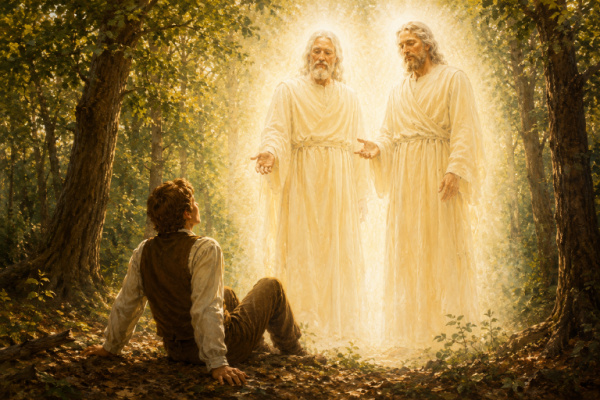
Joseph described praying in a grove of trees when he was overcome by a dark power. After calling upon God, he saw a pillar of light descend from heaven.
He wrote:
“When the light rested upon me I saw two Personages, whose brightness and glory defy all description, standing above me in the air.”
Notice Joseph’s emphasis on their “brightness and glory.” This was no ordinary experience. It was a divine manifestation in which God revealed Himself to a prepared servant.
Latter-day Saints believe that Heavenly Father can reveal Himself whenever He chooses and can preserve the life of the person receiving that revelation. Joseph did not survive because God’s glory somehow became less glorious. He survived because God made it possible.
In fact, the scriptures contain many examples of people seeing God or divine beings.
Isaiah saw the Lord seated upon His throne (Isaiah 6).
Ezekiel saw a glorious heavenly vision (Ezekiel 1).
Stephen, just before his martyrdom, declared:
“Behold, I see the heavens opened, and the Son of man standing on the right hand of God.” (Acts 7:56)
The Apostle John saw the Father and the Son in vision throughout the book of Revelation.
Even in the Old Testament, Jacob declared:
“I have seen God face to face, and my life is preserved.” (Genesis 32:30)
Notice Jacob’s wording. He specifically acknowledges that his life had been preserved. That idea harmonizes beautifully with the Latter-day Saint understanding that seeing God is only possible because God preserves the individual.
Some Bible scholars also point out that Exodus 33:20 may have been referring to seeing the fullness of God’s glory. Earlier in the chapter, Moses had asked, “I beseech thee, shew me thy glory” (Exodus 33:18). God’s response may have been explaining that no mortal could behold the complete fulness of His glory in their natural condition.
Whether understood that way or through latter-day revelation, the principle is the same: God’s glory is overwhelming to fallen mankind, but He can enable whom He chooses to endure His presence.
This understanding is one of the reasons Latter-day Saints do not see a contradiction between Exodus 33:20 and Joseph Smith’s First Vision. Instead, they see a consistent pattern throughout scripture.
Whenever God reveals Himself to mortals, He also gives them the strength, protection, or transformation necessary to survive the experience.
The First Vision wasn’t an exception to the rule—it was another example of it.
Ultimately, Exodus 33:20 teaches us something profound about God’s majesty. His glory is far beyond anything mortal beings can naturally withstand. But it also teaches us something equally comforting: when God desires to reveal Himself, He has the power to prepare His children to receive that blessing.
Joseph Smith’s testimony that he saw Heavenly Father and Jesus Christ fits naturally within that biblical pattern. The same God who strengthened Moses, preserved Jacob, and opened the heavens to Stephen also preserved a 14-year-old boy in a grove of trees, allowing him to witness the beginning of the Restoration.
Gramps