
Question
Gramps,
The scriptures are full of instances in which glorified, resurrected beings appear to mortals in less-than-glorified form (e.g., Christ on the road to Emmaus). Can God the Father do this as well? Is there any reason why He couldn’t or wouldn’t ever appear as anything less than His fully glorified self?
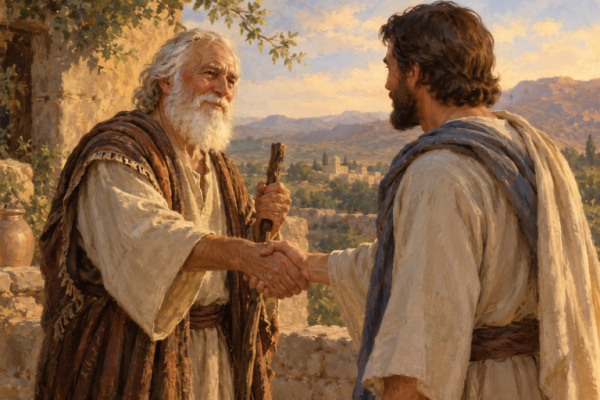
For example, could God the Father appear as an old man, walk and talk with a mortal being, shake their hand, etc.? Or would this somehow violate His divine nature?
Josh
Answer
Josh,
The honest answer is that the Lord has never directly revealed the answer to that question. Because of that, it’s important to distinguish between what the scriptures clearly teach and what we can reasonably infer. While we should avoid presenting speculation as doctrine, there are scriptural principles that help us think about the possibility.
One of the clearest examples comes from the resurrected Savior Himself. After His Resurrection, Jesus walked for several miles with two disciples on the road to Emmaus. They discussed recent events, talked about the scriptures, and even shared a meal together, yet neither disciple realized they were speaking with the risen Lord.
Luke explains simply, “But their eyes were holden that they should not know him” (Luke 24:16). Only later, after Jesus blessed and broke bread, were “their eyes… opened, and they knew him” (Luke 24:31).
The account doesn’t suggest that Jesus had ceased to be a glorified, resurrected being. Rather, for His own purposes, He was not immediately recognized. Whatever the exact mechanism, the story demonstrates that a resurrected being’s glory or identity is not always fully revealed to those around Him.
The same principle appears again only a short time later. When Mary Magdalene encountered the resurrected Savior outside the empty tomb, she initially mistook Him for the gardener (John 20:15). Once again, someone who knew Jesus well did not immediately recognize Him. Whether that was because of Mary’s grief, the circumstances, or the Lord intentionally withholding His identity for a time, the account reminds us that resurrection does not necessarily entail constant public recognition.
The Book of Mormon provides another interesting example. The Three Nephites were translated rather than resurrected, but they were nevertheless changed so they could remain on the earth and continue their ministry. Mormon records that “they are among the Gentiles, and the Gentiles know them not” (3 Nephi 28:27). The Lord also declared that they would become “as the angels of God” (3 Nephi 28:30). Their ministry shows that heavenly servants can move among ordinary people without drawing attention to who they really are.
Even angels frequently appear in very ordinary ways. Abraham welcomed three visitors before realizing that one of them represented the Lord (Genesis 18). Lot received heavenly messengers who appeared simply as men (Genesis 19). Throughout scripture, God’s messengers often look remarkably ordinary until the Lord chooses to reveal more about them.
Taken together, these examples establish an important principle. Heavenly beings are not necessarily required to manifest all of their glory every time they appear to mortals. The Lord seems able to reveal as much—or as little—as accomplishes His purposes.
That brings us back to the original question: Does that principle apply to Heavenly Father?
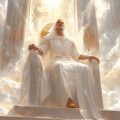
The Restoration teaches plainly that the Father is not merely a spirit or an unknowable force. He is a glorified, resurrected being with a tangible body. Doctrine and Covenants 130:22 declares, “The Father has a body of flesh and bones as tangible as man’s; the Son also.”
Likewise, Joseph Smith taught, “God himself was once as we are now, and is an exalted man” (Teachings of Presidents of the Church: Joseph Smith).
Because the Father possesses a real, tangible body, there is certainly nothing unusual about the idea that He could physically walk, speak, sit, or shake hands. In fact, Joseph Smith’s First Vision leaves little doubt that the Father is a personal Being who can be seen and heard. Joseph testified, “I saw two Personages, whose brightness and glory defy all description” (Joseph Smith—History 1:17).
Other prophets experienced similar manifestations. Stephen saw the Father and the Son before his martyrdom (Acts 7:55–56), and Moses was brought into God’s presence after being spiritually prepared to endure His glory.
That preparation is an important part of the discussion. After Moses’ vision, he explained, “Mine own eyes have beheld God; but not my natural, but my spiritual eyes… for my natural eyes could not have beheld” (Moses 1:11). Likewise, the Lord taught, “No man has seen God at any time in the flesh, except quickened by the Spirit of God” (Doctrine and Covenants 67:11).
These passages teach that when God reveals His full glory, mortals ordinarily must be spiritually strengthened to endure the experience. However, they do not say that God is incapable of appearing in a different manner if He chooses. They simply describe the circumstances surrounding the revelations recorded.
At this point, we arrive at the limits of what has actually been revealed. The scriptures never tell us that Heavenly Father has appeared disguised as an ordinary man, nor do they say that He never could. There simply isn’t a revelation that directly addresses the question.
That means we should be careful not to go beyond what the Lord has revealed. President Dallin H. Oaks has frequently reminded members of the Church to avoid speculation when revelation is silent. That counsel fits this subject well.
Still, it’s also fair to recognize what the scriptures do teach. They consistently demonstrate that glorified heavenly beings can control how much of themselves they reveal. The resurrected Savior was not always recognized. Angels often appeared as ordinary men. The Three Nephites minister unnoticed among the people. Those examples don’t prove that Heavenly Father has done the same thing, but they do show that there is nothing inherently contradictory about a glorified being interacting with mortals without displaying overwhelming glory.
It’s also worth remembering that the Father often accomplishes His work through His Son, through angels, and through authorized servants. Personal appearances by the Father are relatively rare in scripture, not because He is unable to appear, but because He has established an order through which much of His work is carried out. When He has chosen to reveal Himself directly, those experiences have generally been moments of profound revelation, such as the First Vision or His declaration at the Savior’s baptism and on the Mount of Transfiguration.
In the end, the safest conclusion is also the simplest one. We know that Heavenly Father is an exalted, glorified being with a tangible body of flesh and bones. We know He has appeared to prophets in glory. We also know that other glorified heavenly beings have, at times, interacted with mortals without immediately revealing who they were.
Whether Heavenly Father has ever chosen to veil His glory in a similar way is something the Lord has not revealed. There is no doctrinal reason to declare it impossible, but neither is there any revealed doctrine that says He has done so. Faithful Latter-day Saints can comfortably acknowledge that distinction, recognizing that some questions simply await further revelation.
Until then, perhaps the greater lesson is not how God appears, but that He does appear according to His own wisdom and purposes. Whether through His Son, through angels, through the Holy Ghost, or on the rare occasions when He has manifested Himself personally, Heavenly Father has always found ways to reveal Himself to His children when doing so accomplishes His divine purposes.
Gramps