

Question
Gramps,
Were temple ordinances such as endowments and sealings performed during the Book of Mormon time period? I know that temples existed, but I wasn’t sure if the higher ordinances were performed at that time.
Thanks,
Julee
Answer
Julee,
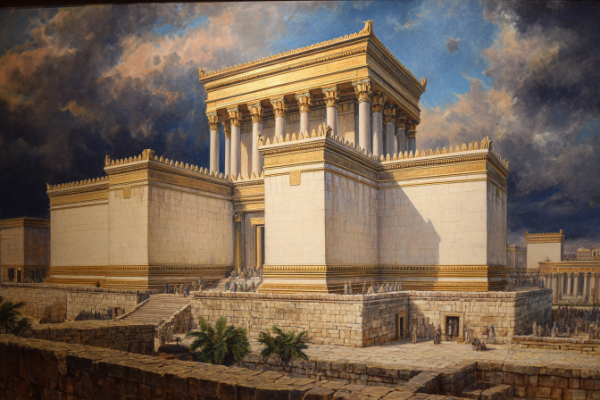
The earliest scriptural temples, such as Solomon’s Temple described in the Old Testament, and the temples mentioned in the Book of Mormon, had unique features and functions. In 2 Nephi 5:16, Nephi recounts building a temple after the manner of the temple of Solomon, though not constructed of so many precious things owing to their scarcity in the new land. The scriptural description of Solomon’s Temple includes details such as the baptismal font on the back of 12 oxen (1 Kings 7:25), a pattern that echoes in modern temple symbolism and design.
But what took place in these ancient temples? Biblical and Book of Mormon records indicate that animal sacrifices and burnt offerings were core practices. These sacrifices symbolized Christ’s offering for humanity’s sins—a shadow of the atonement to come. Temples functioned as sacred spaces for worship, teaching, and ritual purification. However, the specific rituals and ordinances, such as those practiced in modern temples, are not explicitly detailed in the scriptures. Some speculate that the full nature of these ordinances may be covered in the sealed portions of scripture or lost in translation through centuries of scriptural transmission.
Importantly, the ancient rites most often recorded in scripture centered around communal covenant-making and offerings rather than personal or family-focused ordinances that dominate present-day temple practice. These ancient acts of faith laid the foundation for evolving temple worship but differed in important ways from later-revealed ordinances.
With the Restoration through the Prophet Joseph Smith, The Church of Jesus Christ of Latter-day Saints began to receive “line upon line, precept upon precept” regarding the temple and its ordinances. The concept of ordinances necessary for salvation—including the initiatory and endowment, baptisms for the dead, and sealings—emerged gradually throughout the early history of the Church.
Early temple ceremonies, particularly those in Kirtland and Nauvoo, reflected a sacred but evolving ritual structure. As Glen M. Leonard describes, many core elements of today’s initiatory ordinances originated in Kirtland in 1836. Building upon these, Joseph Smith revealed the “endowment,” a ceremony that introduced a narrative about man’s eternal journey, the making of covenants, and the reception of promised blessings. The endowment was initially administered to a select group—the anointed quorum—in secret before being more widely offered to Church members in the Nauvoo Temple after Smith’s death in 1844.
The endowment ceremony itself changed over time to accommodate practical realities: the Nauvoo endowment was vivid and memorable by design, taking about six hours to complete, and included dramatic techniques common in frontier America—acting, ritual clothing, movement between rooms, and narrative instruction. The first written script for the endowment would not appear until the dedication of the St. George Temple in 1877, and the ceremony continued to be refined in subsequent generations.
Additionally, key temple ordinances such as eternal marriage and proxy baptisms for the dead were introduced gradually. Initially, endowments and sealings were performed only for living members; it was not until 1877, in St. George, Utah, that proxy endowments began to be performed for deceased ancestors. Likewise, the sealing of couples beyond the grave and into the eternities was introduced by Joseph Smith and expanded in Nauvoo, becoming a central doctrine of eternal families within the Church.
The comparison between ancient biblical and Book of Mormon temples and today’s temple practices raises significant points of continuity and contrast:
1. Nature of Ordinances:
While ancient temples centered around sacrifice and providing a space for communal worship and instruction, modern temples in the Church are focused on ordinances designed for individual and family salvation and exaltation. As described by Milton V. Bachman Jr., the temple endowment is “to receive all those ordinances in the House of the Lord, which are necessary…to enable you to walk back to the presence of the Father, passing the angels who stand as sentinels, being enabled to give them the key words, the signs and tokens, pertaining to the Holy Priesthood, and gain your eternal exaltation.” This concept of instruction, covenant, and ritual is vastly more explicit and personalized in modern practice.
2. Sacrifice and Atonement:
Ancient temple rituals prominently featured altars for animal sacrifice, which served as a similitude of Christ’s atonement—a practice discontinued in modern temples, as Christ’s ultimate sacrifice rendered such offerings unnecessary. The focus thus shifts from typology and anticipation to ordinances that directly unite participants with Christ’s atonement through covenants and promises.
3. Evolution and Adaptation:
Modern temple ceremonies have evolved in response to changing doctrines, shifting needs, and a deepening understanding of eternal principles. For instance, the endowment ceremony once included an “oath of vengeance” that reflected historical circumstances and cultural context; this provision was later removed during the early 20th century as the Church emphasized integration and reconciliation. Such changes reflect an ongoing process of revelation and adaptation, rather than rigid adherence to a fixed script.
4. Sealing and Eternal Families:
The doctrine of eternal families—sealing spouses and children together into a chain across generations—was not part of ancient temple ordinances but is a distinctive hallmark of modern temple worship. The introduction of these ordinances marks a significant development in the understanding and practice of priesthood authority and the purpose of temple worship within the Church.
As Church President Russell M. Nelson and other leaders have often observed, the central purpose of temples remains unchanged: to bring individuals and families closer to Jesus Christ and the blessings of salvation and exaltation. What is required of each generation is faithfulness to revealed ordinances and openness to ongoing revelation. In this light, ancient and modern temple worship are united by a sacred quest—to prepare the children of God to return and dwell in His presence.
Gramps
Related Posts
 Why are the biblical passages cited in the Book of Mormon essentially identical with those in the Bible?
 What evidence is there that steel was used on the American continent during Book of Mormon times?
 Should I get married in the Mormon Church Temple if my family is against it?
 How do I best prepare myself for the return of my missionary boyfriend?