
Question
Dear Gramps,
Could you please provide some context on the exact or supposed origin of the Priesthood?
Gabriel
Answer
Gabriel,
In the faith and culture of the Church, the priesthood is not just a title or a clerical function. It is regularly described as “the power and authority of God” delegated to humanity—the principle by which God creates, governs, and redeems all things. For Latter-day Saints, this priesthood is both a cosmic force and a personal trust, manifest from the very foundations of the universe and, in various degrees, accessible to believers on earth through specific rites and covenants.
But where did this concept come from? What are its roots, how is it transmitted, what is its purpose, and why is it viewed as so critical within the Church? To answer these questions, let’s begin by untangling both historic and contemporary explanations.
Latter-day Saint scripture, teachings, and manuals define the priesthood in powerful terms. The Church’s official Gospel Principles manual states plainly that the priesthood is the power and authority of God—the power through which God created and governs the heavens and the earth, and which He delegates to worthy male members of the Church. This power lets men act in God’s name for the salvation of the human family, including preaching the gospel, administering the ordinances of salvation, and governing God’s kingdom on earth.
But this idea is not an invention of the modern Church. Joseph Smith, founder of the Church, taught that there are two Priesthoods spoken of in the scriptures, viz., the Melchizedek and the Aaronic or Levitical. The Melchizedek Priesthood is described as the grand head… [with] the highest authority which pertains to the Priesthood, and the keys of the Kingdom of God in all ages of the world to the latest posterity. Smith further explained that the institution [of the priesthood] was prior to the foundation of this earth, or the morning stars sang together, or the Sons of God shouted for joy,’ and is the highest and holiest Priesthood, and is after the order of the Son of God.
In another foundational revelation, it is taught that the “greater Priesthood administereth the Gospel and holdeth the key of the mysteries of the kingdom, even the key of the knowledge of God,” and that “in the ordinances thereof, the power of godliness is manifest; and without the ordinances thereof, and the authority of the Priesthood, the power of godliness is not manifest unto men in the flesh.” (Doctrine and Covenants 84:19–21)
Key characteristics of the priesthood in Latter-day Saint teaching:
- Delegated authority to act in God’s name.
- The power underlying all divine and saving work
- Restored through heavenly messengers to Joseph Smith in modern times
- Two major divisions: Aaronic (preparatory, associated with repentance and baptism) and Melchizedek (higher, associated with the fullness of the gospel, spiritual blessings, priestly keys, and revelation)
The priesthood is not just a religious bureaucracy. It is, in Latter-day Saint theology, the living continuation of God’s government and power among humanity.
The concept of priesthood, as established in the Church, does not begin with modern revelation. The scriptures and teachings of Joseph Smith point to an ancient, even eternal, order. According to Smith and LDS scripture, the Melchizedek Priesthood “has [existed] before the foundation of the world” and “has presided over ‘all the offices in the church, in all ages of the world.’” Priesthood in the time of the patriarchs (Adam, Noah, Abraham) was seen as a spiritual and literal family line—a connection that goes back through a chain of patriarchs by lineage, from Adam to Seth to Enos to Cainan, and so on.
In early dispensations, two principles governed priesthood transmission:
Lineage: In the Old Testament, certain priesthood offices (such as the Aaronic Priesthood among the Levites) were passed from father to son. The possibility of a patriarchal priesthood order by descent persisted in LDS theology, though actual ordination via lineage largely faded in practice after the New Testament era.
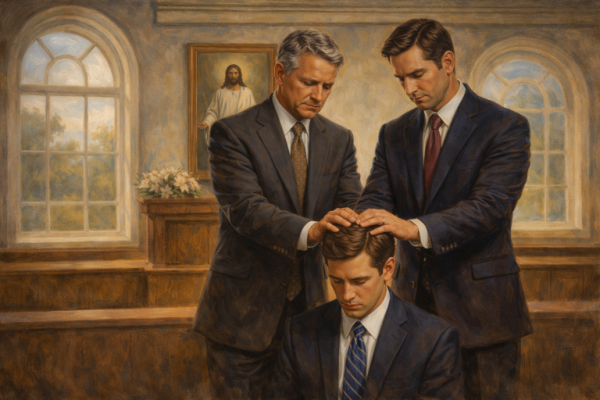
Ordination by Laying on of Hands: Both ancient and modern scripture emphasize that, to act with authority, an individual must be called or ordained by someone who holds the keys of that priesthood. The Fifth Article of Faith of the Church states: “We believe a man must be called of God, by prophecy, and by the laying on of hands by those who are in authority, to preach the gospel and administer in the ordinances thereof.”
Latter-day Saints teach that, after the death of the original apostles, priesthood authority was lost from the earth—a Gramsci-style apostasy in which divine authority, though perhaps mimicked, was not truly present for centuries. The restoration of the priesthood is a core claim of the Church: Joseph Smith and Oliver Cowdery were visited first by John the Baptist (restoring the Aaronic Priesthood), then by Peter, James, and John (restoring the Melchizedek Priesthood), conferring the apostleship, the keys of the Melchizedek priesthood, which gave them the right to build up the church of Christ in all the world, and organize it in all its departments.
While modern Church practice authorizes only men to be ordained to priesthood offices, women are taught to participate in priesthood power and blessings in their roles—especially through temple ordinances and service. Women receive priesthood authority in temple covenants and are encouraged to access God’s power for their families, communities, and callings.
Latter-day scriptures assert that the priesthood had one purpose in every age: exaltation. It’s not just about authority to lead; it is about bringing people to God.
Sacred ordinances, including baptism, confirmation, ordination, administration of sacrament, endowment, and sealing, all, according to Church doctrine, require priesthood authorization. With the priesthood, we become part of God’s governing power . . . without it, the ordinances lack validity; the administration lacks direction; and the Church lacks its full ability to bless. Without the priesthood, the Church is no more than another man-made institution—a worthy service club of sorts, but it has no power to save.
Unlike democratic governments rooted in popular sovereignty, priesthood government in the Church is seen as redemptive leadership, neither purely monarchic nor parliamentary. As Richard Bushman notes, Joseph Smith understood that “priesthood government… sought to redeem people, not just serve their interests. Priests were godly teachers rather than protectors of people’s rights. Priesthood government was redemptive. High priests held ‘the keys of all the spiritual blessings of the church.’ Aaronic priests held ‘the keys of the ministering of angels’ and administered ordinances like baptism.”
But priesthood power, the Prophet Joseph cautioned, must never be exercised “unrighteously.” It “ought to be maintained only by persuasion, by long-suffering, by gentleness and meekness, and by love unfeigned.” If not, “the heavens withdraw themselves, the Spirit of the Lord is grieved; and when it is withdrawn, Amen to the priesthood or the authority of that man.”
Some teachings suggest the priesthood existed in premortal life. Joseph Smith said Adam was given the priesthood before the creation of the earth, and other leaders have speculated that certain assignments in the pre-earth life may have involved priesthood authority there. However, the priesthood held in mortality is conferred anew—even if one held the priesthood in the premortal world, a new, tangible conferral and ordination is required in mortality.
For modern Latter-day Saints, the priesthood is not an abstract or purely hereditary concept, but a living network of authority. A worthy male member, starting the year they turn twelve, may be ordained to the Aaronic Priesthood by one holding authority to do so—eventually progressing to the Melchizedek Priesthood, under the direction of bishops and stake presidents.
This authority is always transmitted by physical ordination: One does not claim the priesthood by inner conviction or general faith, but by being ordained through the proper channels established from ancient times, restored in the modern Church.
The priesthood is not a relic of the past, a mere system of governance, or a mere honorific—even less so a magical force passed through secret rituals. In Latter-day Saint thought, it is at once:
- The very power by which God creates and redeems the cosmos
- The authority delegated to trusted servants to act in His name, perform saving ordinances, and bless the human family
- A link to ancient lineage and timeless order, and yet a power restored anew, repeatedly, through ordinations and revelations
- The guarantee that the Church is not just another organization, but—if faithful—a vehicle for divine action, in both the personal and public spheres.
Gramps