
Question
Gramps,
Why can’t men in leadership positions have facial hair?
Angie
Answer
Angie,
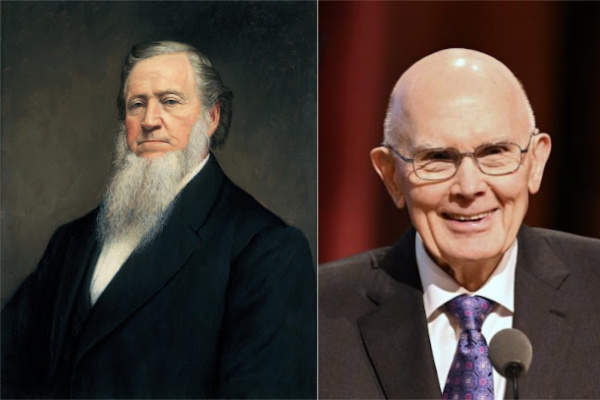
During its early years, facial hair among leaders of The Church of Jesus Christ of Latter-day Saints was not just common but practically universal. All presidents of the Church from Brigham Young (who succeeded Joseph Smith) to George Albert Smith wore full beards, with the clean-shaven Joseph Smith and later David O. McKay marking the major stylistic breaks in presidential appearance. The beard as a symbol of dignity and maturity reflected 19th-century American norms, especially before the widespread availability of safety razors.
As social conventions changed, so too did the appearance of Church leaders. With the advent of improved shaving technology in the early 20th century, clean-shaven faces became increasingly fashionable and were viewed as a symbol of progress and professionalism. This transformation was not limited to religious leaders; from U.S. presidents to businessmen, the shift toward clean-shavenness was widespread in American society. Upon examining Church history, it becomes apparent that no official revelation or scriptural directive was issued regarding the requirement for facial hair; rather, these visible changes reflected society’s preferences at large.
Further complicating the issue was the counterculture of the 1960s and 1970s, during which beards and long hair were adopted as symbols of rebellion and nonconformity. In a religious organization that prizes respectability and social harmony, it was perhaps inevitable that policies and unwritten norms would adjust in response. The 1960s saw increasing pressure within Church-affiliated institutions, such as Brigham Young University (BYU), to reflect the clean-cut standard. BYU President Ernest L. Wilkinson made it clear that the clean-shaven look of missionaries should be emulated by all male students, not because of doctrine, but to present the Church “in the most favorable manner.”
Given the adaptability of social customs, is there any actual written Church policy requiring bishops or local leaders to be clean-shaven? The answer is clear: There is no official policy forbidding beards for bishops or other local leaders in The Church of Jesus Christ of Latter-day Saints. The General Handbook of Instructions does not mention a facial hair requirement for bishops, stake presidents, or other lay leaders.
However, tradition holds significant sway. Anecdotal accounts abound of higher authorities—such as stake presidents—encouraging or even directly requesting newly called bishops to shave their beards. Armand L. Mauss, a well-known Mormon sociologist, described instances where leaders were asked to remove their facial hair as part of accepting a leadership role. Yet, these requests remain informal and vary from region to region, as well as according to the disposition of the presiding authority.
There is also no doctrinal statement or revelation in Church canon that casts facial hair in a negative light. Rather, the discouragement against beards has almost always been justified on cultural grounds. Beards have historically become problematic for local leadership in the context of cultural rebellion—especially as seen through the lens of 1960s youth culture, where long hair and beards were associated with disrespect for established norms and rebellion against authority figures. Elder Paul H. Dunn, at the October 1967 General Conference, linked beards and “grubby clothes” to symptoms of spiritual rebellion, not to incorrect doctrine. Given this cultural association, it was “very likely” that a new bishop would be asked to remain clean-shaven, according to his counsel.
Critically, these unwritten expectations do not carry the force of revelation or systemic policy. Exceptions exist, and personal appearance standards can be informed by the judgment and “inspiration and revelation” of the local leader conducting an interview or extending a call, as explained by former stake presidents. The authority to interview and recommend members for leadership or temple attendance is left largely to the inspiration and discretion of presiding leaders, who may choose to voice their preferences for grooming when they feel it necessary.
So, will we ever see bishops—or even higher leaders—with beards again? Could the winds of tradition one day shift, as they have so often in the past? The answer is: quite possibly.
Commentaries addressing this question are quick to point out that no eternal truths are at stake regarding facial hair. Facial hair, such as beards, has not been declared sinful, noting that the Church’s historical culture and policies regarding appearance may change as society and successive generations reassess the meaning of beards. As this rising generation takes up leadership duties in the Church, they will carry with them their understanding… It is possible that one day we might see a General Authority with a beard. If it happens, it will generate a lot of talk and conversation. But it will be totally meaningless in the ability of the General Authority to do his calling.
A similar logic applies to the role of local bishops. While culture and leadership precedent currently favor the clean-shaven look, these are, at their core, shaped by the conventions of our time. Earlier leaders—including many of the most revered presidents of the Church—wore their beards as badges of distinction and were not considered less dignified or less spiritual for doing so. As conventions evolve, so may leadership grooming standards.
Indeed, there have been calls within the Church community to allow for more flexibility. One bishop from Australia, called to serve as a counselor while sporting a well-kept goatee, was advised that about the only hard-and-fast rule was to follow the guidance of the local stake or mission president—and that he should be “prepared to follow their advice” but need not worry about violating doctrine. In short, personal preference, local culture, and the leader’s inspiration all play vital roles.
Gramps
Related Posts
 Should my mentally handicapped son hold the priesthood in the Mormon Church?
 Why doesn’t the Mormon Church have crosses on their buildings as do other Christian churches?
 Should little children be permitted to bear their testimonies in Sacrament Meeting?
 How Can I Teach My Children Not to Watch Pg-13 Rated Movies?