

Question
Gramps,
Why do we have deacons less than thirty years old, as it used to be in the formation of the Church at Christ’s time?
Alphonse
Answer
Alphonse,
The clearest scriptural foundation for the Aaronic Priesthood—and what those who hold it are meant to do—comes from revelations given to Joseph Smith. In Doctrine and Covenants section 20, the roles of deacons, teachers, and priests are outlined in a pretty straightforward way. Priests, for example, are called to “preach, teach, expound, exhort, and baptize, and administer the sacrament.” Teachers are asked to watch over the Church, strengthen members, and help maintain unity and kindness among them (see Doctrine & Covenants 20:46–55).
When you read those responsibilities, it’s understandable if your first thought is, “That sounds like a lot for someone young.” These are meaningful, even weighty duties. Because of that, some people assume they were originally intended just for adults. And in the earliest days of the Church, that assumption kind of fits—most members were adult converts, so naturally, adult men were the ones filling those priesthood offices.
But that’s only part of the story.
Historical accounts show that young men were also involved much earlier than people sometimes realize. In fact, some were ordained and given real responsibilities in their mid-teens. Don Carlos Smith, for example, served as a missionary at the age of just fifteen. George A. Smith and others were also quite young when they were ordained and began serving. So from the beginning, the pattern wasn’t strictly about age—it was more flexible and adapted to the needs of a growing Church.
As the Church continued to grow and develop, its membership began to change. Instead of being made up mostly of adult converts, more and more families were raising children in the Church. That shift naturally brought new questions and opportunities—especially regarding how young people could be involved and prepared for future responsibilities.
Over time, leaders began to see the value of a more structured approach to the Aaronic Priesthood—one that aligned responsibilities with age and developmental stages. This didn’t happen overnight, but by the early 1900s, things became much more organized. In 1908, the First Presidency introduced guidelines linking specific priesthood offices to certain ages: deacons at 12, teachers at 15, priests at 18, and elders at 21. Along with that, lessons, quorum organization, and expectations were all designed to match those stages.
Leaders at the time spoke openly about why this mattered. Joseph Fielding Smith noted that there wasn’t a single moment when the Aaronic Priesthood suddenly shifted to include youth—it had been happening in various ways from the early days. What changed was the consistency and structure. Instead of being occasional or situational, it became a clear, intentional path for young men.
There was also a strong feeling that this would bless the rising generation. In 1906, Francis M. Lyman shared that Joseph F. Smith believed involving young men in the priesthood earlier would help them grow spiritually and prepare for the future. The idea was simple but powerful: if young men could progress step by step—from deacon to teacher to priest—they would gain experience, confidence, and a deeper sense of responsibility along the way.
By the early twentieth century, it had become clear that ordaining young men wasn’t just practical—it was spiritually beneficial. It helped them develop habits of service, strengthen their faith, and feel like they had a real place in the life of the Church.
Some people wonder whether this age-based system lines up with scripture. It’s a fair question. But when you look closely, most scriptures focus on the authority and responsibilities of the priesthood rather than setting specific age requirements. There are even examples of very young individuals taking on important roles. For instance, Noah is described in Doctrine & Covenants 107 as being ordained at a young age.
Joseph Smith also taught an important principle: that God directs His Church through revelation tailored to the circumstances His people face. In other words, the way things are organized can adapt over time as needs change. That doesn’t mean the doctrine changes—it means the application can be adjusted to best help people grow and succeed.
You can see that same pattern continuing in more recent years. In 2019, the Church made a small but meaningful adjustment by aligning priesthood advancement with the year a young man turns a certain age (12, 14, or 16), rather than waiting for his exact birthday. It’s a practical change, but it also helps create a sense of unity and shared progression among youth.
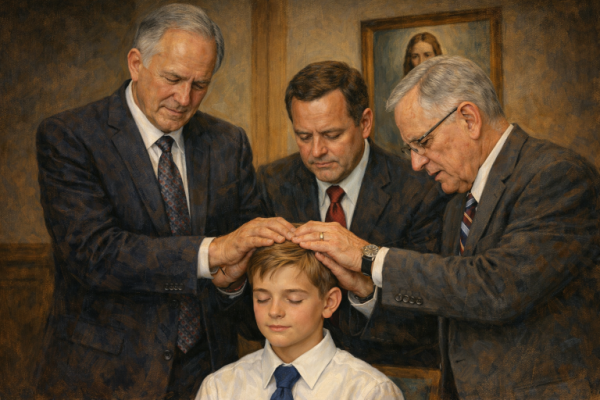
Today, being ordained to the Aaronic Priesthood is a central part of a young man’s experience in the Church. And it’s not just symbolic—these young men are trusted with real responsibilities. They prepare, bless, and pass the sacrament, which represents the Atonement of Jesus Christ. They serve others, support their families and congregations, and begin learning what it means to lead with humility and faith.
And really, that’s the heart of it. The priesthood isn’t about age—it’s about being called of God and striving to live worthy of that calling. Throughout history, there have been powerful examples of young people stepping into significant spiritual roles. Joseph Smith was just fourteen at the time of the First Vision, and Joseph F. Smith was only fifteen when he was called to serve a mission in Hawaii.
Those examples, along with modern practice, highlight a consistent pattern: young people are capable of meaningful spiritual responsibility. As they are trusted, taught, and supported, they grow into that responsibility in remarkable ways.
So rather than seeing the Aaronic Priesthood as something reserved for adulthood, it can be helpful to see it as part of a gradual, guided journey—one that begins in youth and continues throughout a lifetime of service, growth, and discipleship.
Gramps