
Question
Gramps,
Why was section 101 of the original printing of the D&C changed regarding monogamy vs polygamy? Specifically, verse 4, which states that we do not believe in polygamy. Also, why were early church leaders practicing polygamy while our own scripture teaches against it?
Kyle
Answer
Kyle,
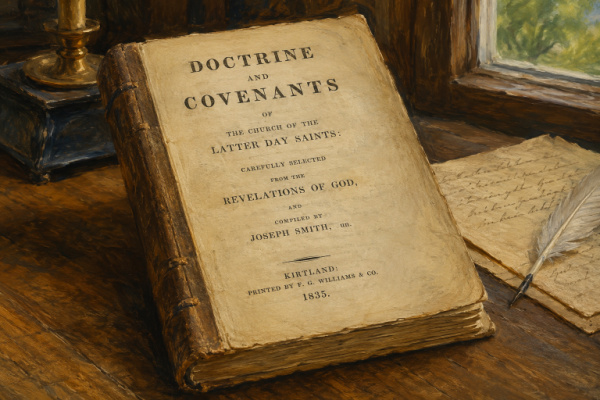
The first thing to understand is that the original Doctrine and Covenants section 101 is not the same section 101 found in today’s Doctrine and Covenants. In the 1835 edition, section 101 was an “Article on Marriage” that the Church adopted for publication. Unlike most sections of the Doctrine and Covenants, it was not presented as a revelation received by Joseph Smith, but as a statement explaining the Church’s beliefs and practices regarding marriage.
Verse 4 stated:
“Inasmuch as this church of Christ has been reproached with the crime of fornication, and polygamy: we declare that we believe, that one man should have one wife; and one woman, but one husband, except in case of death…”
At face value, that certainly sounds like an outright rejection of plural marriage.
Readers can examine the original document for themselves in the 1835 edition of the Doctrine and Covenants, preserved by the Joseph Smith Papers.
So why was it later removed?
In 1876, under the direction of President Brigham Young, the Doctrine and Covenants was reorganized. The “Article on Marriage” was removed, and the revelation now known as Doctrine and Covenants 132 was added to the canon. Section 132 was dictated by Joseph Smith on July 12, 1843, and records the revelation on eternal marriage and explains the commandment to practice plural marriage under specific circumstances.
This naturally leads to the harder question.
If Joseph Smith had already received the revelation on plural marriage, why publish a statement saying the Church believed only in monogamy?
According to the Church’s official Gospel Topics essay, Joseph Smith appears to have learned about the principle of plural marriage as early as 1831 while studying the Old Testament. However, the revelation was not written down until 1843, and the practice was introduced only gradually and confidentially to a small group of trusted followers. During the 1830s, nearly every Church member was living in a monogamous marriage and knew nothing about plural marriage.
The Church’s Gospel Topics essay explains:
“Latter-day Saints believe that monogamy—the marriage of one man and one woman—is the Lord’s standing law of marriage.“
The essay also acknowledges that plural marriage was introduced gradually and that many details remain uncertain because participants were instructed to keep the practice confidential.
From that perspective, many LDS historians believe that the 1835 marriage statement accurately described the Church’s public practice. The Saints generally were not practicing plural marriage, and Church leaders were also responding to accusations that the Church promoted “spiritual wifery” and sexual immorality—charges they vigorously denied.
At the same time, the historical record creates understandable questions.
Evidence accepted by the Church indicates that Joseph Smith likely entered into at least one plural marriage during the mid-1830s and later introduced the practice more broadly in Nauvoo. If that is the case, then at least some Church leaders were practicing plural marriage while the 1835 marriage statement remained in the Doctrine and Covenants.
For many readers, this is the most difficult part of the story.
Some conclude that the statement appears inconsistent with what was happening privately. Others believe the statement reflected the Church’s public practice, while confidential instructions had been given only to a limited number of people under what Joseph Smith believed was a divine command. The Church acknowledges that many details of this period remain incomplete because the practice was intentionally kept confidential.
It is important to recognize that faithful Latter-day Saint historians do not claim this history is free of difficult questions. Whether one accepts the Church’s explanation or finds some aspects unresolved, there is broad agreement that the transition from the 1835 “Article on Marriage” to Doctrine and Covenants 132 represents one of the most complex periods in Restoration history. Understanding the historical context—including the gradual introduction of plural marriage, the practice’s confidential nature, and the later canonization of Section 132—helps explain why many sincere members have wrestled with these events while continuing to seek understanding through study and faith.
Another important point is that monogamy has always been presented as God’s normal pattern for marriage in LDS doctrine.
This surprises many people.
The clearest example comes from the Book of Mormon.
Jacob taught:
“For there shall not any man among you have save it be one wife; and concubines he shall have none.” (Jacob 2:27)
Only three verses later, however, the Lord provides an important exception:
“For if I will, saith the Lord of Hosts, raise up seed unto me, I will command my people; otherwise they shall hearken unto these things.” (Jacob 2:30)
Current Church teaching understands this exception as the scriptural basis for the temporary commandment to practice plural marriage during certain historical periods.
Doctrine and Covenants 132 teaches that Joseph Smith was commanded to restore this ancient practice, much as Abraham, Isaac, Jacob, Moses, and other Old Testament prophets had lived it under God’s direction. Church leaders have consistently taught that plural marriage was never intended to become the permanent pattern for the Church but was a temporary commandment given for purposes known to the Lord.
That period officially ended when President Wilford Woodruff issued the Manifesto in 1890, announcing that the Church would no longer enter into new plural marriages. Today, plural marriage is not authorized in The Church of Jesus Christ of Latter-day Saints, and anyone who enters into a plural marriage is subject to Church discipline.
So how should Latter-day Saints view the apparent contradiction between the 1835 marriage statement and later revelations?
Many faithful members conclude that the two documents were addressing different situations. The 1835 “Article on Marriage” described the Church’s public practice and was not itself a revelation. Doctrine and Covenants 132, on the other hand, records a revelation that Church leaders believed authorized an exception to the normal rule of monogamy for a limited period under prophetic direction.
Others acknowledge that the historical tension is real and that not every question has a complete answer. The Church itself notes that many details surrounding the early practice of plural marriage remain unknown because the historical record is incomplete.
What is clear today is the Church’s current position. Monogamy is the Lord’s standing law of marriage. Plural marriage was practiced only under what early Church leaders believed was a temporary divine command, and it has not been authorized in The Church of Jesus Christ of Latter-day Saints for well over a century. Understanding that distinction helps explain why the 1835 “Article on Marriage” was eventually replaced by Doctrine and Covenants 132, even though the history surrounding that transition continues to invite careful study and thoughtful discussion.
Gramps