

Question
Gramps,
I noticed in THE CHOSEN that Jesus raised his arm to the square when commanding Lazareth to come from the tomb. We use that in the temple. What does the arm raised signify or mean?
Dyan
Answer
Dyan,
I had to take a look at that scene again to see what you were talking about. The first time I watched it, I didn’t get the impression it was supposed to be “raising the arm to the square.” If it was, it seemed to be a poor imitation. But I can understand someone else seeing it that way.
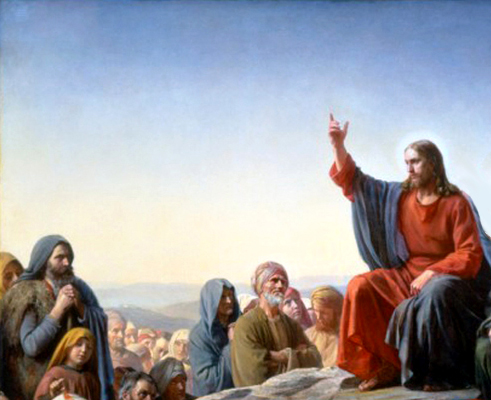
To me, it felt more like a rallying gesture — kinda like “Hey, look at me!” It is rather entertaining to note that, as a Latter-day Saint, I didn’t perceive it being close enough to the proper gesture to call that the arm-to-the-square. And yet many evangelicals saw it as a betrayal for him to use an LDS gesture in the show.
The depiction in The Greatest Story Ever Told was bereft of any gestures. And it seemed a bland depiction (it was supposed to be a movie, after all). Some sort of gesture would have been more dramatic.
I liked what Jonathan Roumie did with it. He seemed to be calling power down from heaven. And it was very dramatic, so much so that it created some backlash. But I still wouldn’t call that the arm-to-the-square (even though others would disagree).
On to your question: What does the arm-to-the-square mean? Excellent question. I’m glad you asked.
Biblically speaking, the raising of the right hand meant having power and authority (Ex 3:19-20) as well as giving blessings (Leviticus 9:22) and making covenants (Genesis 14:22).
To a Latter-day Saint, it means all those things and more. For example,
Covenants, blessings, and ordinances
When making a covenant or performing an ordinance with the Lord, we have three participants:
- Us
- The priesthood holder officiating the covenant
- The Lord.
The arm raised to the square connects us all. The horizontal portion is the bond between mortals (the participant + the officiator, as well as any witnesses). The vertical portion is the bond between man and the Lord.
This idea can be extrapolated to all priesthood actions done with the arm to the square, as well as when we raise our arms in sustaining individuals to their callings.
Temple Symbols
We try to make it as close to a square as possible because it reminds us of the Temple symbols of the compass and the square. The square is on the right side, hence the right hand. The compass makes a circle. The square makes… wait for it… a square.
When a circle inscribes a square (i.e., the circle is drawn inside the square to touch all four sides), this is an ancient symbol of the Primordial Mound. The square represents the earth (as in the four corners of the earth), and the circle represents heaven (as in one eternal round). This is a concept found in many ancient cultures as the place where heaven and earth meet. In fact, there are many instances in scripture where God met with man on the top of a mountain (like Mt. Sinai). Jerusalem itself is a city built on a plateau in the midst of the Judean mountains. And the boundaries of The Old City are more or less a square.
Other cultures include:
- In Greek Mythology, the gods lived on Mt. Olympus.
- In Chinese myth, the creator god Pangu became the Five Sacred Mountains. These are sites of sacred rituals and are seen as the connection point between heaven and earth.
- The Shinto of Japan revere Mt Fuji as the place where the gods reside and pilgrims can receive heavenly healing and good fortune.
- Among the Vikings, they viewed the mountains as the place where the power of the deity and the power of man met.
There is a reason we call the temple “The Mountain of the House of the Lord.” For us, it is the primordial mound where heaven and earth meet. Thus, it is the perfect place to perform the highest sacraments of our faith.
Symbols tend to mean a lot more to us when we understand what the symbols are supposed to be. So, I’m very grateful for your question.
Gramps