

Question
Gramps,
What is the history of baptism?
Charles
Answer
Charles,
Baptism, in Christ’s original Church, was not optional; it was never just a symbolic gesture to be performed after one felt emotionally converted. Instead, it was—in the words of early Christians—“an inseparable part of the salvation process. In fact, there was no salvation without it.” The scriptures and early Christian authors collectively declared four primary purposes for baptism:
1. Essential for Salvation and Entrance into the Kingdom of God:
Baptism is a non-negotiable step—Jesus told Nicodemus that being “born of water and of the Spirit” was required to enter God’s kingdom (John 3:5). Early Christian writers affirmed that “unless therefore they receive saving baptism they cannot be saved.”
2. Necessary for the Remission of Sins:
Baptism was, and is, God’s chosen method of washing away sins—not the water itself, but through the cleansing power of Christ’s atonement. As Peter declared on the day of Pentecost: “Repent, and be baptized every one of you in the name of Jesus Christ for the remission of sins, and ye shall receive the gift of the Holy Ghost” (Acts 2:38). Justin Martyr, an early Christian apologist, explained that converts prayed and fasted “for the remission of their sins that are past…Then they are brought by us where there is water, and are regenerated in the same manner in which we were ourselves regenerated.”
3. A Witness of One’s Faith and Commitment:
Throughout history, some have argued that faith alone is sufficient and that baptism is only an outward sign. However, scriptural evidence, including Paul’s teachings in Romans, emphasized that our outward actions, such as baptism, are inextricably connected to our inward faith. Tertullian, another early writer, referred to baptism as “a sealing of faith”—an act that completes and confirms our faith.
4. A Drama of Death, Burial, and Resurrection:
Perhaps most powerful is the symbolism embedded in baptism by immersion. Paul described how in baptism we are “buried with him by baptism into death,” and as we come forth from the water, we rise “in the likeness of his resurrection” (Romans 6:3-5). The water becomes both a grave and a womb: a place where the “old man” dies and the “new man” is born—a “spiritual birth.”
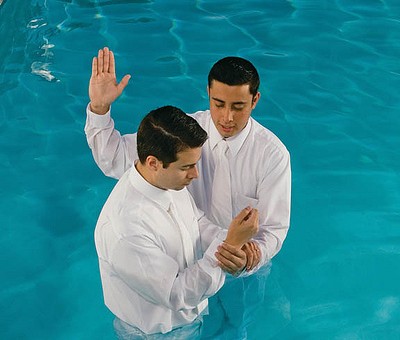
In the Church, baptism is not just a step—it is a covenant, “a sacred agreement between God and a person or group of people.” Candidates for baptism undergo an interview where they express their willingness to keep God’s commandments, take upon themselves the name of Christ, and serve Him faithfully. The immersion in water before witnesses, following the specific prayer, is a physical acceptance of this covenant, and God promises the baptized the constant companionship of the Holy Ghost, remission of sins, spiritual rebirth, and eternal life—if they honor their promises.
Early Christian records, the Book of Mormon, and modern revelation agree: baptism is to be performed by immersion by one with proper authority. Christ set the example, being baptized by immersion in the Jordan River even though He was sinless—“to fulfill all righteousness” and show the “straitness of the path…by which [all] should enter.” Nephi explained, “If even the Son of God must be baptized…then surely there is no other way for us.”
In every New Testament case, immersion is the mode. For example, both Jesus and others are described as going “down into the water” and “coming up out of the water” (Matthew 3:16, Acts 8:38). Paul’s metaphors of burial and planting only fit full immersion—not sprinkling or pouring.
Early church writers confirmed this:
– Tertullian: “We are immersed in the water.”
– Justin Martyr: “The water immersion is performed…”
– Bishop Bennet: “They laid them down in the water as a man is laid in a grave… then they raised them up again, and clean garments were put on them…”
The Lord, through modern revelation (Doctrine and Covenants 20:73-74), declared the exact mode and prayer for baptism in the Church. The individual authorized to baptize “shall go down into the water with the person… and shall say, calling him or her by name:
‘Having been commissioned of Jesus Christ, I baptize you in the name of the Father, and of the Son, and of the Holy Ghost. Amen.’
Then shall he immerse him or her in the water, and come forth again out of the water.”
The language is simple, direct, and covers every theological necessity without verbosity. As B. H. Roberts observed, “Not a superfluous word in it—direct—covering all the ground necessary, and yet how simple withal!”
In the centuries after Christ and the Apostles, human tradition began to erode the beautiful simplicity of the ordinance. Elaborate rituals were introduced:
– Salt placed in the mouth of the baptized as an emblem,
– Rites of exorcism performed in preparation,
– Adornments with crowns and white robes,
– Anointings, symbolic feedings of milk and honey,
– Restriction of the timing of baptisms to festival days after long preparation.
Despite these intentions, each addition was “a step towards the fulfillment of the prophecy…[that they] changed the ordinance, broken the everlasting covenant” (Isaiah 24, as referenced).
Crucially, the form of baptism itself was altered. “The general rule among Christians is to baptize by sprinkling or pouring. For this change, there is no warrant of revelation. It destroys the symbol there is in baptism as taught by Messiah and his apostles—that of a burial and resurrection.” Infant baptism—first rare, then common—likewise perverted the doctrine, as infants are incapable of faith or repentance, the prerequisites of the ordinance.
As Tad Callister described, once the form was altered, its meaning also changed. “How could pouring or sprinkling be symbolic of the death, burial and resurrection of Christ…?”
Early Christians fiercely debated whether baptism performed by heretics was valid—the consensus was that only baptisms done by proper authority counted, underlining the importance of priesthood commission.
The restoration reaffirmed both the doctrine and the manner of baptism:
– Performed by immersion,
– Using the exact form given by revelation,
– By one holding proper authority from Jesus Christ.
Such continuity anchors the Church in the original Christian tradition and testifies to the doctrine’s enduring relevance.
Gramps