
Question
Gramps,
I have started to reread the Book of Mormon again this year, and early on, the Nephites are able to obtain the plate of brass, which “they were the record of the Jews, a record of many of the prophesies from the beginning down to and including part of those spoken by Jeremiah.” My question is, if the records were taken to the “new world” with Nephi, where did the manuscript for the bible come from?
Doyle
Answer
Doyle,
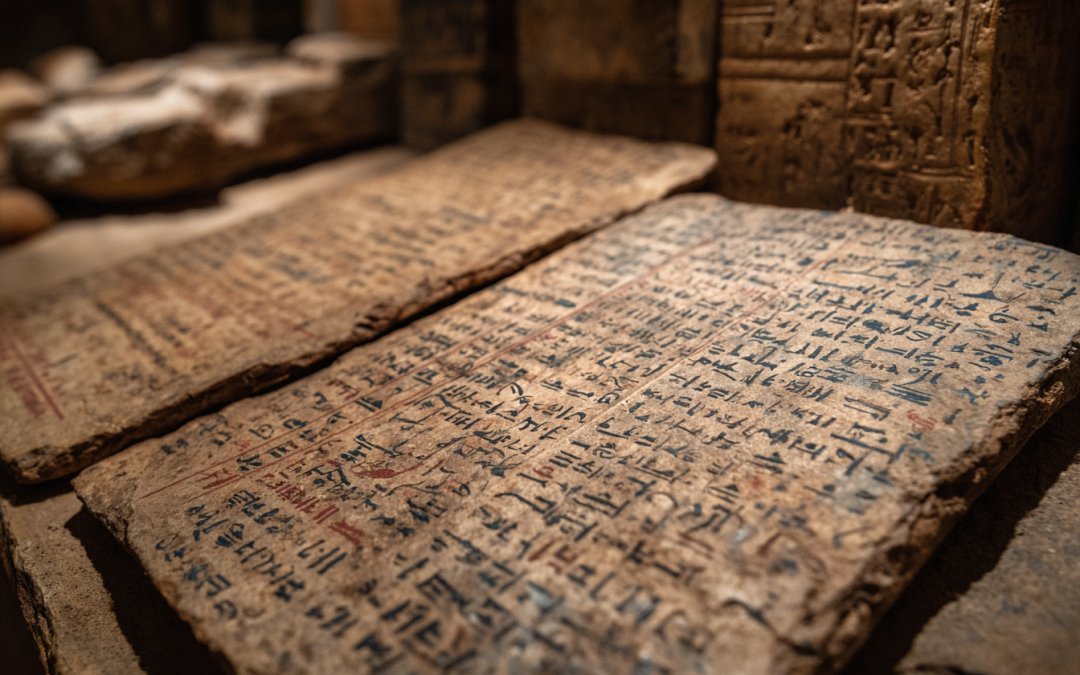
According to leading scholars and historical evidence, none of the original manuscripts of the Gospels—or any other New Testament book—have survived. There are no original manuscripts for any of the Gospel accounts. Every text we now possess is the result of generations of copying and recopying, and the earliest extant fragments are themselves copies, not originals.
The oldest surviving New Testament manuscript is a tiny papyrus scrap known as P52. It contains a few verses from the Gospel of John and, according to expert paleographical analysis, dates to the early second century CE—decades after the events it describes and the author’s supposed lifetime. No scholar places it earlier than about 125 CE, and no other New Testament manuscript has been securely dated before 150 CE.
This means there is a minimum gap of 50-100 years, often much more, between any putative eyewitness record of Jesus’ ministry and the earliest manuscript copies we hold today. As scholars David P. Barrett and Phillip Wesley Comfort have summarized:
The earliest known New Testament manuscript is P52, a fragment of John’s Gospel. The papyrus fragment was dated by various paleographers to the first half of the second century—even to the first quarter… No one would commit to a date earlier than A.D. 125. No other New Testament manuscript has been assigned a date prior to A.D. 150 with any kind of consensus.
Not only are there no surviving originals, but early Christian writers do not appear to have had access to them even in their own day. As Sir Frederick Kenyon wrote,
“The originals of the several books have long ago disappeared. They must have perished in the very infancy of the Church; for no allusion is ever made to them by any Christian writer.”
This suggests that these vital links with the past vanished swiftly—possibly mere decades after being written.
Some may wonder: if we do not have the originals, what do we have, then? The answer: an astonishing number of later copies—over 5,400 Greek manuscripts of all or part of the New Testament, with countless variations between them. Yet the earliest of these partial manuscripts appear in significant numbers only from the third and fourth centuries onward.
The process of copying sacred texts in the ancient world was far from perfect. The earliest copyists were, by scholarly consensus, often untrained. They made frequent mistakes—misspellings, skipped lines, omissions, even intentional alterations to harmonize the text or reflect personal beliefs. Scholar Bart D. Ehrman notes:
The earliest copyists appear to have been untrained and relatively unsuited to the tasks; they made lots of mistakes, and these mistakes were themselves then copied by subsequent copyists…. Unfortunately, none of the original copies of any of the books of the New Testament survive, nor do any of the first copies nor any of the copies of the copies.
It was not until centuries after Jesus’s time that large, relatively complete, and carefully produced manuscripts became common. The most respected, relatively full manuscripts—Codex Vaticanus, Codex Sinaiticus, and Codex Alexandrinus—date from the fourth century CE and were produced, it is generally agreed, in Egypt.
What does this process mean for our New Testament? It has produced a truly breathtaking variety of readings, insertions, and omissions. Scholars estimate that there are more textual variants among the surviving manuscripts than there are words in the New Testament itself. Each line of text has been through centuries of change—sometimes subtle, sometimes significant.
While this staggeringly complex history does not erase the witness or message of Jesus, it greatly complicates scholarly attempts to reconstruct the “original” text or words of any Gospel eyewitness. As John W. Burgon observed already in the 19th century:
The omission of words, clauses, and sentences was the most frequently occurring type of corrupt variation from the genuine Text of the Bible. Inadvertency may be made to bear the blame of some omissions, but it cannot bear the blame of shrewd and significant omissions of clauses which invariably leave the sense complete.
The discovery of the Dead Sea Scrolls in 1947 electrified both scholars and the faithful. Would these ancient documents—hidden away for two millennia—contain new, direct eyewitness accounts of Jesus? The answer, again, is no. The Dead Sea Scrolls include ancient Jewish scriptures, apocrypha, sectarian writings on community life and beliefs, and fragments of the entire Hebrew Bible except Esther—but nothing written by any eyewitness of Jesus, nor any original New Testament document.
Before the Dead Sea Scrolls, there were stories (even legends) of texts hidden in caves or jars. Early Christian writers, such as Eusebius, reported that Origen found a translation of the Psalms in a jar near Jericho. In the 800s CE, the patriarch Timotheus I recounted that Hebrew scrolls were found in a cave and removed by Jerusalem Jews. But none of these finds was a direct eyewitness account of Jesus, nor even a first-century Christian document.
Additional caches of Christian and Jewish texts have been found—at sites like Khirbet Mird, associated with early monasteries, and in southern Judean caves—but all are later copies or fragments, sometimes bearing witness to early Christian communities but never to direct eyewitnesses of Jesus.
Physical decay, persecution, the fragility of papyrus, war, and time have all conspired to undermine the survival of original texts. Moreover, as Dr. Frederick C. Grant noted,
“A gap of at least two or three centuries between any present text and the originals is present. Surely anyone with a sense of history must be concerned about what changes could have occurred during that time, without apostolic leadership to correct errors and with no original manuscripts for honest folk to use for comparison.”
For many, the absence of any original Gospel—or any first-generation Christian document—raises questions about the authority and reliability of our texts. Yet this loss is not unique to Christianity. Nearly all documents from antiquity survive only in copies created centuries later. The difference is that, with the Bible, countless individuals throughout history have poured their hearts into preserving and transmitting what they saw as sacred.
Members of The Church of Jesus Christ of Latter-day Saints affirm the Bible as scripture, “as far as it is translated correctly,” even while recognizing its deprivations and the loss of original manuscripts. They also see the process of loss and restoration as prophesied and fulfilled through additional scripture, notably the Book of Mormon, which claims to restore those “plain and precious things” lost from the Bible (see 1 Nephi 13:25–28).
While scholars labor over ancient fragments and debate variants, the absence of originals also invites reliance on revelation, spiritual confirmation, and the collective witness of generations rather than the words of a single document. As B. H. Roberts of the Church noted,
“The Bible, in spite of its deficiencies, is still a marvelous record of God’s dealings with mankind and tells of Jesus’ ministry among the Jews. However, the Prophet Joseph Smith, even as a boy, discovered that the Bible was sufficiently vague in some very important doctrinal matters….”
Gramps