

Question
Gramps,
Why do we use oil when giving blessings?
Marla
Answer
Marla,
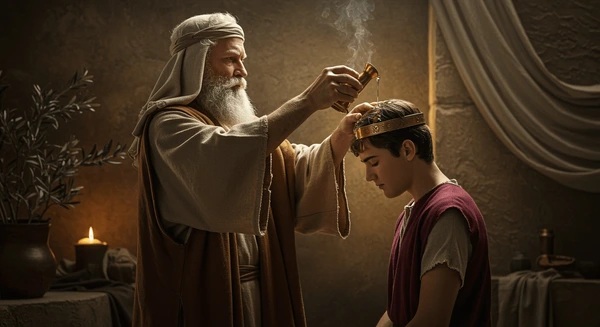
The concept of anointing is not unique to contemporary Church practices. The earliest written account dates to the time of Moses, when the Israelites, freshly delivered from Egypt, constructed a tabernacle in the wilderness. The Lord commanded Moses to consecrate not only people—such as Aaron and his sons—but also sacred objects used in temple worship, using olive oil as the medium of anointing. Exodus 30 describes set practices: “Moses consecrated Aaron for his priestly temple duties by anointing him with oil and setting him apart through the laying on of hands.”
Olive oil held special significance in ancient Israel. It was used to anoint prophets and priests, as well as kings (such as Saul, David, and Solomon), and also sacred temple instruments. Anointing signified being set apart—made holy—for God’s work. It was a public, tangible sign that the recipient or object was now dedicated to a divine purpose.
The symbolism resonated deeply; the act itself represented purification, sanctification, and the bestowal of divine authority or blessing. Notably, prophets throughout the Old Testament were repeatedly commanded to use oil to set apart those chosen by God for significant callings or healings, emphasizing the ritual’s sacred gravity.
Why is olive oil, specifically, still used for anointings? Anciently, as well as today, olive oil is a powerful symbol. It was considered the “cleanest, clearest, brightest-burning, longest-lasting of all animal and vegetable oils”—pure, useful for food, healing, and fuel for lamps. For the Israelites, olive oil’s value was immense—not only did it nourish the body as food, but it also soothed wounds and provided light.
In this way, olive oil becomes a fitting symbol for Jesus Christ. He is the source of spiritual nourishment, healing, and light. The very words “Messiah” in Aramaic and “Christ” in Greek both mean “the Anointed One”—highlighting Jesus’s unique relationship to the act of anointing and sanctification. For members of the Church, this connection underscores every anointing as a reminder that real power comes through the grace and mediation of the Savior.
But the oil’s symbolic power is only invoked after it is set apart by proper priesthood authority. As explained in Church instructions, only 100% olive oil is to be consecrated and used for blessings; blends or other types do not meet the scriptural pattern. Once properly blessed, the oil is always to be viewed as a holy instrument in God’s hands—not a magical substance, but a tangible sign of faith, obedience, and the Lord’s promise.
In modern times, anointing with consecrated oil is most commonly performed as part of priesthood blessings for the sick. Anointing is an essential element of healing priesthood blessings, but it is not limited to that; it also plays a role in temple ordinances and, in rare cases, in setting apart individuals for sacred duties. The process consists of two main steps: one Melchizedek Priesthood holder anoints the individual with oil, and then another seals the anointing by laying hands on the recipient’s head and offering a prayer of faith.
A memorable story shared by Elder Glen L. Rudd illustrates this principle beautifully. He recalled visiting a gravely injured 12-year-old girl, Janice, who had suffered devastating injuries after a severe accident. With faith and following the prescribed pattern—anointing followed by sealing a blessing—she was blessed to recover with no lasting effects. Against all odds, Janice later became a mother and grandmother, never suffering any ill effects from her injuries.
As Elder D. Kelly Ogden explained, “We apply hands and oil, the physical touch and the tangible substance, but the hands and the oil do not heal. It is faith in Jesus Christ and the power of the priesthood that heals. The ordinance—with its physical actions and symbols—focuses the faith of all involved on the Savior, serving as a powerful reminder of His power to heal and bless.
Importantly, the Church has a prescribed process for consecrating oil, detailed in official Church handbooks and family guidebooks. Any 100% olive oil—not necessarily extra virgin, but pure—may be consecrated by worthy Melchizedek Priesthood holders. While the oil itself will degrade over time, there is no spiritual deficiency if old or new oil is used, as long as it is pure and properly set apart. Many priesthood holders carry keychain vials of consecrated oil with them, ready to administer this powerful ordinance in moments of need.
A significant discussion in recent years concerns who can use consecrated oil and administer priesthood blessings. Some have misunderstood talks by Church leaders about women and priesthood power—misconstruing statements by President Russell M. Nelson about women “sharing in the priesthood” as permission for women to anoint and bless with oil.
It’s crucial to clarify: in The Church of Jesus Christ of Latter-day Saints, women participate fully in receiving priesthood power through covenants, especially in temple settings. However, the actual laying on of hands with consecrated oil as part of priesthood blessings is reserved for those who have been ordained to the Melchizedek Priesthood and are worthy.
As President Nelson taught, “Sisters, you have the right to draw liberally upon the Savior’s power to help your family and others you love.” However, he explained that this is not accomplished through the same outward ordinances as men who bear the priesthood. Rather, women access priesthood power primarily through covenant faithfulness, service, and inspiration from the Holy Ghost.
In practice:
– Only worthy Melchizedek Priesthood holders may consecrate oil and perform anointings.
– Women do not use consecrated oil or lay hands on heads to pronounce blessings; their engagement with priesthood power is deeply spiritual and partnership-based, not ordinance-based.
This delineation is not to diminish anyone’s faith or access to God’s power, but to honor divinely established patterns for ordinances within the Church.
Many members wonder about the practicalities of anointing. Does consecrated oil have to be extra virgin? What about blends, or oil that has been stored for a long time? The answer is straightforward: The only requirement about the oil is that it must be 100% olive oil, no blends. Any other factors that determine different qualities are not important. Once the oil has been consecrated by a proper authority, no further preparation is required before use.
While extra virgin olive oil might be considered the finest, it is not spiritually superior or required. Old oil can degrade and lose its clarity, so many practitioners choose to refresh their vials periodically for comfort and hygiene, but this is a matter of personal preference.
Another common question is whether a blessing can be given without oil if none is available. In such cases, Melchizedek Priesthood holders may lay hands on the head and offer a prayer of faith, trusting fully in the Lord’s mercy and will. The ordinance can still be effective, anchored as always in the faith of the recipient, those giving the blessing, and ultimately, in Jesus Christ.
Those who perform the ordinance should seek to be worthy, but as Joseph Fielding Smith once observed, “An elder’s worthiness is not as important as the faith of the individual. He is a conduit for the Lord, and the focus is not on him.” The Lord honors the principles of faith and obedience, using humble instruments to accomplish His healing and sanctifying work.
Gramps
Related Posts
 When blessing a baby, do we ask the Lord for blessings or pronounce blessings on the baby?
 Is it an act of faith or a lack to faith to repeatedly importune our Father in Heaven on behalf of a loved one who is ill?
 Could a priesthood blessing help my non-member girlfriend who has a terminal illness as a result of experimenting with satanic rituals?
 Valid Priesthood Blessings