
Question
Gramps,
If the Priesthood is the power of God given to men on earth, why was it not restored first? Would this power and authority not be required to substantiate the restoration of the gospel?
Poki
Answer
Poki,
Great question. We could also ask the question: Wouldn’t such authority be foundational to any effort to reestablish Christ’s true Church on earth?
To appreciate why the priesthood was not the very first thing restored in the modern era, it is crucial to first understand its nature and purpose. The priesthood, as revealed and taught by leaders of The Church of Jesus Christ of Latter-day Saints, is the authority to act in the name of God. It is more than simply receiving divine assistance or spiritual gifts; it encompasses both power and the authority to preside, administer, and perform the saving ordinances required for salvation.
It is possible—indeed, often witnessed in scripture and daily life—for individuals to accomplish great things with God’s help without holding a priesthood office. For example, prophets in the Old Testament often fulfilled their callings through inspiration and power before they were specifically assigned to priesthood offices, as later practices dictated. Priesthood authority formalizes this capability, providing a degree of spiritual power and organizational stewardship necessary for building and maintaining Christ’s Church on earth, as outlined in Doctrine and Covenants 84:33-40.
When Joseph Smith began his divine calling, he was often prompted to exercise spiritual gifts—receiving revelation, translating ancient records, and guiding others spiritually—before being formally ordained to a priesthood office. This progression points to an important principle: spiritual power and divine assistance can precede and prepare the way for the restoration of full priesthood authority, much as spiritual awakening precedes the establishment of Church order.
The notion of priesthood authority lies at the heart of why a restoration—or restoration of all things—was necessary in the first place. Following the culmination of Christ’s mortal ministry, the early Church was organized with apostles, prophets, evangelists, pastors, and teachers. Peter, James, and John were called as a presidency to guide the fledgling Church. However, persecution soon followed, leading to the martyrdom of the apostles. The general priesthood authority, centralized in the apostles, was lost as each was killed or, in John’s case, exiled.
Local bishops held limited authority from the general Church leaders, but as the lines of succession were broken and the last bishops ordained by the apostles died, priesthood authority to administer gospel ordinances and organize the Church on earth perished. The absence of this authority led to what is known as the Great Apostasy—a period during which much gospel truth was obscured or lost, and priesthood authority was no longer to be found on the earth.
President Boyd K. Packer, a senior apostle of The Church of Jesus Christ of Latter-day Saints, explained, “We owe an immense debt to the protesters and the reformers who preserved the scriptures and translated them. They knew something had been lost. They kept the flame alive as best they could. Many of them were martyrs. But protesting was not enough; nor could reformers restore that which was gone.” The Cloven Tongues of Fire
This environment persisted through centuries of darkness and spiritual drought. However, God did not wholly abandon humanity. Reformers preserved key elements—like the Bible—that would later make the Restoration possible. Events like the invention of the printing press and the rise of constitutional government created the social, intellectual, and religious climate necessary for the birth of a new dispensation of the gospel. As the world was thus prepared, a fourteen-year-old Joseph Smith experienced a vision in 1820, in which God the Father and Jesus Christ appeared to him, commissioning him to restore true Church and priesthood authority.
The question yet lingers: Why wasn’t priesthood authority restored first? Why did Joseph Smith receive revelation, translation gifts, and even certain commandments before receiving priesthood ordination?
The Restoration process exemplified a divine order and wisdom. As Joseph Smith’s ministry progressed and the translation of the Book of Mormon neared completion (with the need to administer ordinances and organize believers into a Church), the time for the restoration of priesthood authority arrived.
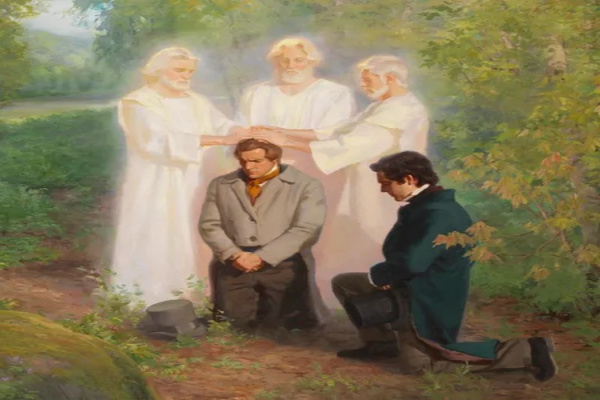
On May 15, 1829, John the Baptist appeared to Joseph Smith and Oliver Cowdery, conferring upon them the Aaronic Priesthood—enabling them to baptize and perform other basic ordinances. Soon after, Peter, James, and John (the original ancient apostles) appeared, conferring the Melchizedek Priesthood, with higher powers including the right to give the gift of the Holy Ghost and preside over the Church. By the time The Church of Jesus Christ of Latter-day Saints was organized on April 6, 1830, Joseph and Oliver held sufficient priesthood authority to officially lead and establish the organization and administer all essential ordinances.
A fascinating aspect of the period between apostasy and restoration is the role of translated beings who continued to reside on earth, such as John the Beloved and the Three Nephites, as featured in the Book of Mormon. While these individuals retained priesthood office and power, they were hidden from the world. Critically, they did not possess or were not granted the keys necessary to restore priesthood authority or reorganize Christ’s Church. The authority required for the Restoration rested in resurrected or divinely sent messengers—such as John the Baptist, Peter, James, and John—rather than in those who remained incognito throughout the centuries.
The loss of public priesthood authority did not mean all gospel truth disappeared, or that God abandoned His children entirely. Rather, it meant that key ordinances necessary for salvation and the organization of Christ’s true Church could not be performed until they were restored by those authorized to do so. The dim candlelight of truth endured, but the bright light of the restored gospel had to await the divine timetable.
Another dimension to consider is the relationship between the priesthood in the premortal existence and the priesthood conferred in mortality. According to prophetic teachings, the priesthood is the authority to act in God’s name, both in the premortal world and in mortality. Adam and others held a form of priesthood authority before coming to earth to fulfill their callings in the heavenly council. Joseph Fielding Smith and other authorities affirmed that assignments and priesthood existed in the spirit world. Still, upon entering mortality, a physical conferral and ordination were always required for mortals to act in priestly capacities on earth.
This emphasizes an important truth: spiritual authority and stewardship are context-dependent. The priesthood necessary to govern and save in the mortal realm is conferred through earthly ordination, regardless of premortal assignments or premortal spiritual status.
The Restoration of priesthood authority in the latter days carries massive theological and practical implications for The Church of Jesus Christ of Latter-day Saints, as well as the world at large.
From Adam’s dispensation to the time of Christ, cycles of apostasy and restoration followed the loss of priesthood authority. The Restoration, however, through Joseph Smith, was unique. This final dispensation—called “the fulness of times”—was prophesied by Daniel (Daniel 2:44) and others to never end in apostasy but eventually fill and transform the earth. In October 1831, Joseph Smith received a revelation stating, “The keys of the kingdom of God are committed unto man on the earth, and from thence shall the gospel roll forth unto the ends of the earth, as the stone which is cut out of the mountain without hands shall roll forth, until it has filled the whole earth” (Doctrine & Covenants 65:2).
One of the remarkable evidences of the Restoration is the ability of every priesthood holder in the restored Church to trace his authority back to Jesus Christ Himself, through an unbroken succession of laying on of hands. This lineage was not possible during the Great Apostasy and is unique to the modern-day Church.
As the Church organizes throughout the world, the restored priesthood administers gospel ordinances, directs the work of salvation, and unifies believers. This is made possible by the priesthood keys and authority restored through Joseph Smith and his successors. The Restoration thus provides not only theological roots but living fruits—blessings daily available to millions of men, women, and children across the globe.
For all seeking light, hope, and divine guidance, the story of the Restoration and the return of priesthood authority stands as a testament that God still speaks, still leads, and still loves His children—inviting all to come and partake of the fullness of His gospel blessings.
Gramps