
Question
Gramps,
According to Wilford Woodruff’s journal, President George Washington, John Wesley, Benjamin Franklin, and Christopher Columbus were ordained high priests when they appeared within the sacred walls of the St. George Temple. Why did these ordinations take place in our sphere by a mortal man?
John
Answer
John,
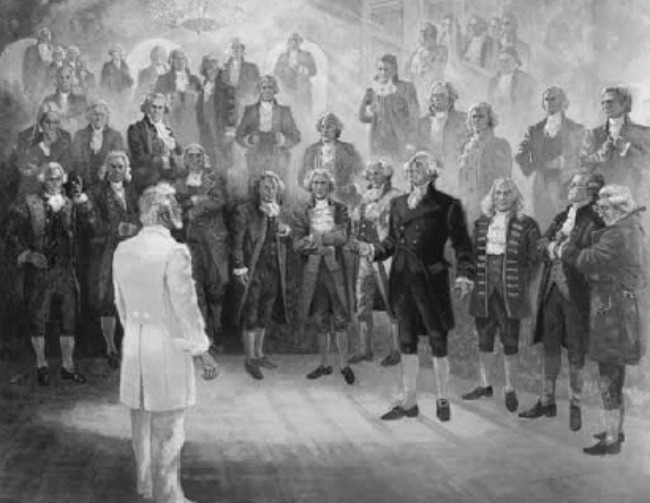
In the spring of 1877, within the sunlit sandstone walls of the St. George Temple in southern Utah, a singular event unfolded in the annals of The Church of Jesus Christ of Latter-day Saints. President Wilford Woodruff, then president of the temple, reported receiving visits from the “spirits of the dead”—notably, the founding fathers of the United States and other historic figures—who requested that their redemptive ordinances be performed. President Woodruff remarked, “They waited on me for two days and two nights…These were the signers of the Declaration of Independence…[who] wanted the blessings of the gospel in their lives.”
Central to Latter-day Saint doctrine is the conviction that saving ordinances—baptism, confirmation, ordination to the priesthood, endowment, sealing—must be performed by living persons acting under priesthood authority, even for those who have passed beyond the veil of mortality. This practice, called “vicarious” or “proxy” work, is rooted in biblical principles and clarified by modern revelation.
Wilford Woodruff’s experience is emblematic of this doctrine. According to his testimony, the spirits of the signers of the Declaration of Independence expressed their desire for temple blessings: “We laid the foundation of the government you now enjoy, and we never apostatized from it, but we remained true to it and were faithful to God.” Understanding their yearning, President Woodruff explained, “I straightway went into the baptismal font and called upon brother McCallister to baptize me for the signers of the Declaration of Independence, and fifty other eminent men, making one hundred in all, including John Wesley, Columbus, and others; I then baptized him for every President of the United States, except three…”
The theological basis comes from teachings like those found in 1 Peter 4:6, “the dead [will] be judged according to men in the flesh, but live according to God in the spirit.” This principle was fleshed out by modern leaders and scholars. As explained in the Encyclopedia of Mormonism, “Mortals on earth will perform saving ordinances such as baptism on their behalf…Conversion takes place in the spirit world, but the ordinances are performed vicariously on earth among mortals.” The reason? Simply put, the ordinances belong to and must be recorded in this life. The late Joseph Fielding Smith, former president of the Church, taught, “Baptism, confirmation, ordination, endowment, and sealings all pertain to this mortal life and are ordinances required of those who are in mortality. Provision has been made for these ordinances to be performed vicariously for those who are worthy but who died without the opportunity in this life…If it were permissible for resurrected persons to come and do work in the temples, then there would be no reason for us in this mortal life to act vicariously for them, for they would do it for themselves.”
The idea is clear: Earth is the sphere of mortality and probation, where covenants are made, sealed, and recorded. Death does not nullify a person’s opportunity to receive the gospel, but the performance of those ordinances is reserved for living bodies acting on earth.
What makes the events at the St. George Temple especially significant is their intersection of historical narrative and sacred vision. According to multiple accounts, President Woodruff received visits—not merely dreams, but protracted pleadings—by the spirits of America’s Founding Fathers, who entreated him to ensure their redemptive work be done. Lorenzo Snow corroborated the doctrine that great historical figures were inspired of God to further the Restoration, observing “the providences of God in raising up a Luther, a John Wesley; we see the providences of God in all the Christian organizations and communities; we trace the hand of the Almighty in framing the constitution of our land…”
President Ezra Taft Benson, decades after the original experience, visited the vault of the St. George Temple to see the records with his own eyes, later sharing: “Think of it, the Founding Fathers of this nation, those great men, appeared within those sacred walls and had their vicarious work done for them…President George Washington was ordained a High Priest at that time. You will also be interested to know that according to Wilford Woodruff’s journal, John Wesley, Benjamin Franklin, and Christopher Columbus were also ordained High Priests at the time.”
A particularly striking episode is Benjamin Franklin’s return. Wilford Woodruff recorded that after the work had been performed for Franklin, Franklin appeared in a dream, requesting yet more ordinances, further reflecting both the urgency and reality of this vicarious work.
This living connection—these “choice spirits…the best spirits the God of heaven could find on the face of the earth”—emphasized that the project of the Restoration, and the liberation of humanity from spiritual bondage, is not limited by death but transcends generations and nations.
Several doctrinal and practical reasons have been highlighted by leaders and historians regarding why mortals are to perform ordinances for the dead:
Agency and Opportunity: The spirit world is a place of continued learning and accepting the gospel, as referenced in Doctrine & Covenants 138. Spirits who never heard the gospel can choose to accept or reject the ordinances performed in their behalf, preserving agency.
Linking Generations: The ordinances not only offer redemption to individuals but serve as a means of “turning the hearts of the children to the fathers, and the hearts of the fathers to the children,” as prophesied by Malachi and confirmed in the restoration of Elijah’s sealing powers.
Priesthood Authority on Earth: The physical body, granted in mortality, is essential for enacting covenants and priesthood ordinances. John the Baptist’s instruction to Joseph Smith and Oliver Cowdery—wherein he did not perform baptisms himself but commanded the men to baptize and ordain each other—is cited as scriptural precedent. As Church scholar Kent P. Jackson summarizes, “Conversion takes place in the spirit world, but the ordinances are performed vicariously on earth among mortals. The sealing power of Elijah’s keys makes those ordinances binding both on earth and in heaven.”
Record and Law: The scriptural principle that ordinances are to be “recorded on earth” as well as “in heaven” underscores the symbolic and literal necessity of mortal performance (see Doctrine & Covenants 128:6-9). Records made in mortality represent binding, legal acts within God’s kingdom.
Preparation for Judgment: Mortality is viewed as a probationary period; after the resurrection, the judgment is set, and the window for performing such gospel work closes. Thus, performing ordinances in mortality is foundational for their ultimate acceptance and effect.
In this framework, the work of redeeming the dead—whether 18th-century statesmen or ancient ancestors—requires reliance on living faith, physical participation, and recorded order on earth.
These temple ordinances performed for the Founding Fathers invite reflection on why America occupies such a significant position in the Latter-day Saint worldview. The Church teaches that the development of the United States’ constitutional government and religious freedoms was no mere political coincidence, but a deliberate preparation for the Restoration of the gospel.
Latter-day Saint thinker Tad R. Callister, echoing generations of prophetic counsel, wrote: “God was not passionately interested in the development of America as a political entity alone—that was the means, not the end. The ultimate goal was to provide a forum where his Church could be restored in its fulness, never again to be taken from the earth. That was the crowning aim in God’s blessing of America.”
The appearance of the Founding Fathers and historical figures in the St. George Temple is preached as both evidence and symbol: that the heavens are open, that the work of God spans temporal and spiritual realms, and that liberty—famously invoked in the words of Franklin, Washington, and others—was established on earth to facilitate the redemption of all humanity.
Gramps